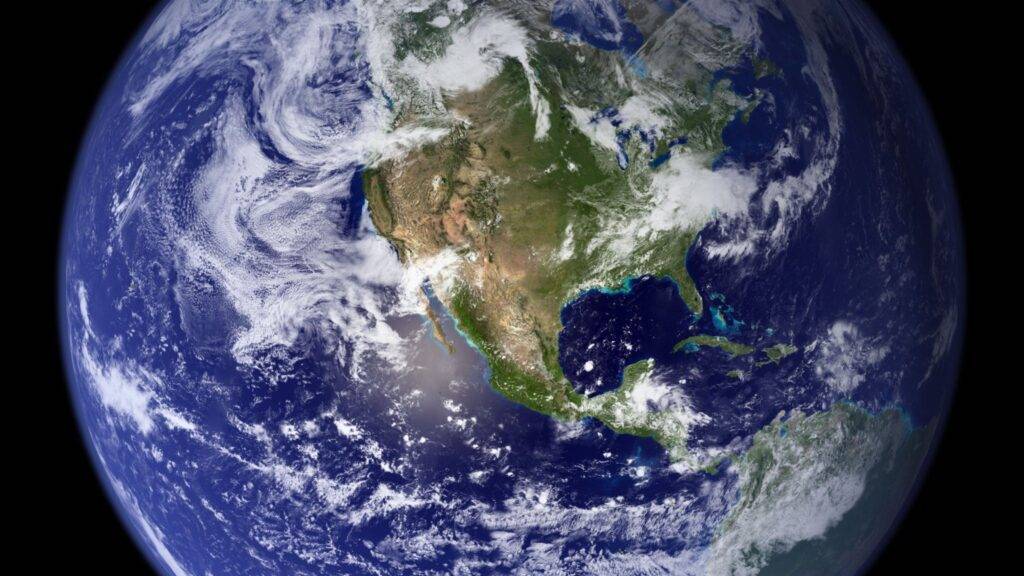
How did Earth form, and what processes shaped its early evolution? The topic of the Origin of Earth in Environmental Geosciences addresses these fundamental questions by examining planetary formation, geological differentiation, and the emergence of Earth’s atmosphere and hydrosphere. Mastering these concepts is essential for UGC-NET/JRF, SLET, ARS, GATE, and other competitive examinations.
Use this curated MCQ bank to assess your conceptual understanding, identify knowledge gaps, and strengthen your preparation for competitive examinations.
Syllabus Outline
- Modern theories on the origin of the Earth.
- Earth’s orbital parameters, Kepler’s laws of planetary motion, and the Geological Time Scale.
- Space and time scales of processes in the solid Earth, atmosphere and oceans.
- Radioactive isotopes and their applications in geochronology and geothermometry.
- Origin of the atmosphere and hydrosphere and their evolution.
- Origin of the lithosphere and biosphere and their interactions.
- Weathering, erosion, transportation and deposition of sediments.
- Geochemical classification of elements and their distribution in the Earth.
Quick Study Guide
The origin and early evolution of Earth are governed by astrophysical accretion, thermodynamic cooling, and atmospheric transformation. Understanding these foundational mechanics explains how a barren protoplanet developed the precise geological and atmospheric conditions required to sustain the biosphere.
- Solar Nebula and Accretion Dynamics: Earth formed approximately 4.54 billion years ago within the spinning solar nebula. Cosmic dust particles clumped together via electrostatic forces, growing into planetesimals. Continuous high-velocity gravitational collisions allowed the proto-Earth to clear its orbital path, accumulating mass through cold accretion.
- Thermal Evolution and the Magma Ocean: The early Earth transformed into a completely molten mass due to three distinct heat sources: kinetic energy from relentless meteoritic bombardment, gravitational compression, and the rapid decay of short-lived radioactive isotopes (such as aluminium-26). This extreme thermal energy created a global magma ocean.
- The Giant Impact Hypothesis (Origin of the Moon): A Mars-sized protoplanet named Theia collided obliquely with the young, molten Earth. The immense energy of the collision completely vaporised Theia and ejected a massive volume of Earth’s silicate mantle into orbit. This debris ring rapidly accreted to form the Moon, while Theia’s dense metallic core sank and merged with Earth’s core.
- Atmospheric Outgassing: Earth’s initial primordial atmosphere (mostly hydrogen and helium) was completely stripped away by powerful solar winds. A secondary atmosphere was generated through volcanic outgassing, which released volatile compounds trapped within the mantle. This early atmosphere was highly reducing, composed primarily of water vapour, carbon dioxide, and nitrogen, with zero free oxygen.
- Condensation and Hydrosphere Formation: As meteoritic impacts declined, Earth’s surface radiatively cooled. Once surface temperatures dropped below the critical boiling point of water, water vapour in the steam-saturated atmosphere condensed into torrential, continuous rainfall. This immense precipitation accumulated in low-lying crustal basins, creating the oceans.
Test Your Knowledge
This quiz contains 25 concept-based MCQs on “Origin of Earth and Planetary Differentiation“. Each question has a single correct/most appropriate answer.
*****
1. Which geological phenomenon played a crucial role in releasing gases from the Earth’s interior, contributing to the development of the atmosphere?
a) Landslides
b) Volcanic activity
c) Earthquakes
d) Glacial melting
2. The concept of continental drift was proposed by:
a) Alfred Wegener
b) James Hutton
c) Charles Lyell
d) Arthur Holmes
3. What process led to the formation of the Earth approximately 4.6 billion years ago?
a) Volcanism
b) Sedimentation
c) Accretion
d) Erosion
4. The process of differentiation in the early Earth led to the formation of a semi-fluid layer called:
a) Exosphere
b) Lithosphere
c) Hydrosphere
d) Asthenosphere
5. Which planetesimal is thought to have contributed significantly to the Earth’s water content?
a) Metallic asteroid
b) Carbonaceous asteroid
c) Chondrite
d) Basaltic asteroid
6. The theory suggesting that the Moon formed from debris ejected during a collision between Earth and a Mars-sized body is known as the:
a) Impact hypothesis
b) Co-formation theory
c) Capture theory
d) Fission hypothesis
7. What term is used to describe the gradual accumulation of matter in the early solar system, leading to the formation of planetesimals?
a) Fusion
b) Condensation
c) Differentiation
d) Accretion
8. The concept that explains the movement of heat in the Earth’s mantle through the upward movement of hotter material and the downward movement of cooler material is known as:
a) Advection
b) Conduction
c) Convection
d) Radiation
9. The concept of isostasy refers to:
a) Equilibrium in the Earth’s crust
b) Upward movement of similar molten rock
c) Folding and faulting of similar rocks
d) Formation of similar sedimentary rocks
10. The solar nebula collapsed under its gravity and formed a rotating disk. What did most of the material in this disk eventually become?
a) Comets
b) Asteroids
c) Sun
d) Moon
11. The process of mantle plumes rising from the deep mantle and causing volcanic activity is associated with:
a) Rift valleys
b) Transform faults
c) Hotspots
d) Subduction zones
12. The concept of seafloor spreading is associated with the movement of tectonic plates at:
a) Transform faults
b) Mid-ocean ridges
c) Continental rifts
d) Subduction zones
13. Which process contributed to the differentiation of the Earth, leading to the formation of distinct layers such as the core, mantle, and crust?
a) Erosion
b) Weathering
c) Volcanism
d) Plate tectonics
14. The intense bombardment during the early stages of Earth’s formation contributed to what characteristic of the planet?
a) Tectonic plate movement
b) Ocean currents
c) Magnetic field
d) Atmospheric composition
15. The Earth’s lithosphere is broken into several pieces called:
a) Joints
b) Folds
c) Plates
d) Faults
16. What is the primary component of the Earth’s core?
a) Silicon
b) Aluminum
c) Oxygen
d) Iron-nickel alloy
17. What role did planetesimals play in the early solar system?
a) Development of comets
b) Expansion of the solar nebula
c) Growth of protoplanets
d) Formation of asteroids
18. The Wilson Cycle describes the cyclical process of:
a) Seafloor spreading
b) Plate collisions
c) Volcanic eruptions
d) Mountain building and erosion
19. Which region is characterised by the downward bending of the Earth’s crust, often associated with oceanic trenches?
a) Hotspot
b) Transform fault
c) Subduction zone
d) Rift Valley
20. Which era of geological time is associated with the formation of the Earth?
a) Cenozoic
b) Precambrian
c) Palaeozoic
d) Mesozoic
21. Which process involves denser oceanic plates sinking beneath less dense continental plates?
a) Seafloor spreading
b) Subduction
c) Rifting
d) Orogeny
22. What is the approximate age of the Earth, based on current scientific estimates?
a) 1 billion years
b) 3.2 billion years
c) 4.6 billion years
d) 2.5 billion years
23. The Earth’s magnetic field has undergone reversals in its polarity. What term is used to describe these magnetic field reversals?
a) Magnetic inversions
b) Geomagnetic anomalies
c) Paleomagnetic flips
d) Polar flips
24. What is the primary source of heat that drives the processes of plate tectonics on Earth?
a) Gravitational pull
b) Solar radiation
c) Geothermal energy
d) Radioactive decay
25. The process of orogeny is associated with:
a) Seafloor spreading
b) Plate subduction
c) Earthquakes
d) Mountain building
*****
Previous: Environmental Biotechnology
Next: Concept of Minerals and Rocks
References
- Edward A. Keller (2022). Introduction to Environmental Geology, Pearson, 5th Edition.
- Sharma, P. D. (2017). Environmental Biology and Toxicology, Rastogi Publications, 3rd Edition.
- De, Anil Kumar and De, Arnab Kumar (2024). Environmental Chemistry, New Age International, 11th Edition.
- Odum, Eugene P., and Barrett, Gary W. (2004). Fundamentals of Ecology, Thomson Brooks/Cole, 5th edition.
- Singh, J.S., Gupta, S.R., Singh, S.P. & Singh, R. (2026). Ecology, Environmental Science and Conservation, S Chand Publishing, 2nd Edition.
- Erach Bharucha (2017). Environmental Studies, Universities Press, 4th Edition.
🔗 Explore More MCQs: