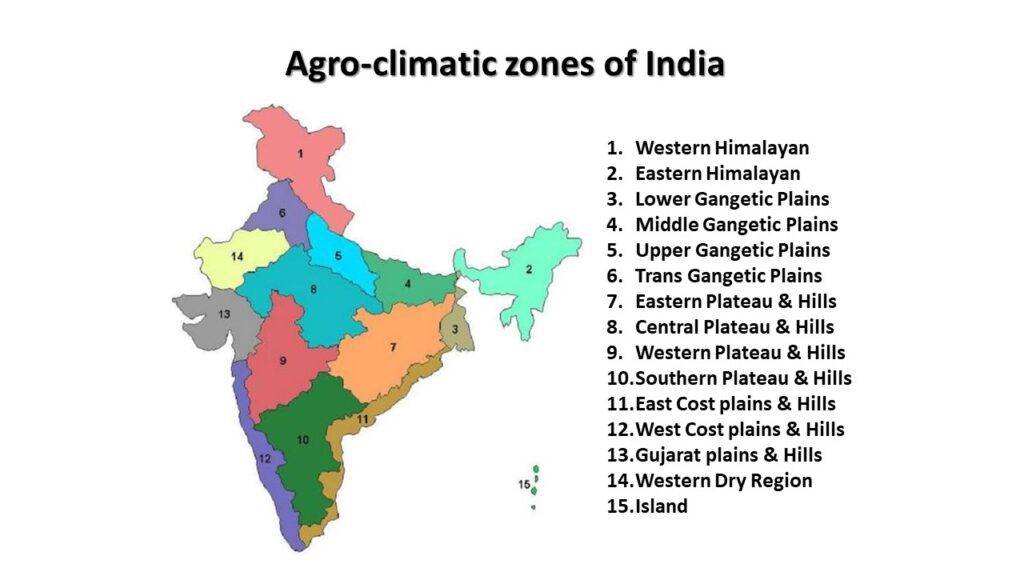
Agro-climatic Zones of India deal with India’s geographical regions based on climatic conditions, soil types, and topography, which significantly influence agricultural practices and crop selection. Therefore, it is an important subject for UGC-NET/JRF, SLET, GATE, and other competitive examinations.
Use this curated MCQ bank to test your conceptual depth, identify weak areas, and sharpen your exam readiness.
Syllabus outline
- Definition and significance of agro-climatic zones in agricultural planning.
- Historical development and classification methods.
- Climatic parameters affecting agricultural productivity (temperature, precipitation, humidity, and wind patterns).
- Soil types, fertility, and water availability in different regions.
- Overview of the various agro-climatic zones in India and their characteristics.
- The division of India into different zones based on climate, soil, and topography.
Quick Study Guide
India’s agro-climatic zones represent a strategic geographic division based on climate, topography, soil characteristics, and water resources. This classification is vital for optimising regional agricultural potential and planning sustainable farming strategies. By linking physical geography with agricultural output, these zones explain why specific crops ranging from water-intensive rice to drought-resistant millets are restricted to distinct regions based on their environmental constraints.
- Climatic Parameters and Crop Selection: An agro-climatic zone is primarily defined by its temperature, rainfall, humidity, and soil type. These specific environmental conditions strictly dictate which crops can thrive. For instance, the heavy rainfall and alluvial soils of the Gangetic Plain support water-intensive rice, while the semi-arid Western Dry Region is suited to drought-resistant coarse millets.
- Himalayan and Mountain Regions: Altitude-driven climates dictate specialised farming in the mountains. The Western Himalayan zone is known for temperate fruits (like apples) and cold-weather crops such as barley. In contrast, the North-Eastern Hills, characterised by steep terrain and heavy rainfall, are highly optimised for tea cultivation and dense forestry.
- The Plains and River Basins: The vast northern plains form India’s agricultural backbone due to deep, fertile alluvial soils and extensive river networks. Regions like the Punjab and Gangetic plains rely on massive irrigation systems fed by Himalayan rivers to sustain high, reliable yields of staple crops like wheat and rice.
- Coastal and Plateau Regions: Coastal zones experience tropical climates with heavy monsoon rains, making them ideal for high-value cash crops. The west coast is famous for spices (pepper, cardamom) and plantation crops (rubber, coffee), while the east coast excels in rice and jute. Inland, the central plateaus utilise moisture-retaining black soils to dominate in the production of cotton, oilseeds, and pulses.
- Arid and Semi-Arid Adaptations: Regions facing water scarcity, such as the deserts of Rajasthan, require highly adapted agricultural practices. These zones rely on resilient, low-water crops like sorghum (jowar), pearl millet (bajra), and drought-resistant oilseeds. Understanding these zones highlights the ecological limitations and soil chemistry required to farm in challenging environments.
Test Your Knowledge
This quiz contains 25 concept-based MCQs on “Agro-climatic zones of India”. Each question has a single correct/most appropriate answer.
1. Which agro-climatic zone in India is known for coarse cereals like pearl millet and sorghum?
a) Western Dry Region
b) Eastern Plateau and Hills
c) Gangetic Plain Region
d) Gujarat Plains Region
2. The Western Rajasthan Desert agro-climatic zone is famous for which crop?
a) Oilseeds
b) Pulses
c) Wheat
d) Cotton
3. Which agro-climatic zone in India is highly suitable for temperate fruit cultivation like apples and pears?
a) Western Himalayan Region
b) Southern Plateau and Hills
c) Western Dry Region
d) Eastern Himalayan Region
4. Which agro-climatic zone is characterised by its cold climate and is known for apple and potato cultivation?
a) Eastern Himalayan Region
b) Western Himalayan Region
c) Western Dry Region
d) Southern Plateau and Hills
5. Assertion (A): The Punjab Plains agro-climatic zone is known for its extensive wheat cultivation.
Reasoning (R): The Punjab Plains receive sufficient irrigation from the Indus and its tributaries, making it favourable for wheat cultivation.
a) Both A and R are true, but R is not the correct explanation of A.
b) Both A and R are true, and R is the correct explanation of A.
c) A is true, but R is false.
d) A is false, but R is true.
6. Assertion (A): The Western Coastal Region of India is suitable for coffee and black pepper cultivation.
Reasoning (R): The Western Coastal Region receives heavy rainfall and has a tropical climate, creating favourable conditions for coffee and black pepper cultivation.
a) Both A and R are true, but R is not the correct explanation of A.
b) A is true, but R is false.
c) Both A and R are true, and R is the correct explanation of A.
d) A is false, but R is true.
7. The Bundelkhand agro-climatic zone is suitable for which crop cultivation?
a) Rice
b) Pulses
c) Wheat
d) Oilseeds
8. The Bihar Plains agro-climatic zone is famous for which crop cultivation?
a) Cotton
b) Rice
c) Pulses
d) Wheat
9. Which agro-climatic zone is characterised by its hot and humid climate, making it suitable for sugarcane and jute cultivation?
a) Gujarat Plains Region
b) Southern Plateau and Hills
c) Western Coastal Region
d) Eastern Coastal Region
10. India’s Western Dry Region agro-climatic zone is known for which crop cultivation?
a) Millets
b) Pulses
c) Jute
d) Sugarcane
11. Which agro-climatic zone in India is highly suitable for spices like cardamom, ginger, and turmeric cultivation?
a) Western Himalayan Region
b) Western Coastal Region
c) Eastern Plateau and Hills
d) Eastern Coastal Region
12. Which agro-climatic zone in India is more suitable for tropical fruits like papaya and pineapple cultivation?
a) Eastern Coastal Region
b) Eastern Plateau and Hills
c) Western Coastal Region
d) Gangetic Plain Region
13. The North-Eastern Hills Region agro-climatic zone is famous for which crop cultivation?
a) Rice
b) Tea
c) Cotton
d) Jute
14. The Odisha Plains agro-climatic zone is known for which crop cultivation?
a) Rice
b) Wheat
c) Pulses
d) Cotton
15. Assertion (A): The Gangetic Plain Region in India is characterised by its fertile alluvial soil, making it suitable for rice cultivation.
Reasoning (R): The Gangetic Plain Region receives abundant rainfall and is drained by several rivers, including the Ganges, providing ideal conditions for rice cultivation.
a) A is true, but R is false.
b) A is false, but R is true.
c) Both A and R are true, but R is not the correct explanation of A.
d) Both A and R are true, and R is the correct explanation of A.
16. The Central Plateau and Hills agro-climatic zone is known for the cultivation of which crop?
a) Sugarcane
b) Millets
c) Oilseeds
d) Pulses
17. Which agro-climatic zone in India is more suitable for tropical fruits like mango and banana cultivation?
a) Eastern Plateau and Hills
b) Gangetic Plain Region
c) Western Coastal Region
d) Eastern Coastal Region
18. Assertion (A): The Odisha Plains agro-climatic zone is suitable for rice and oilseed cultivation.
Reasoning (R): The Odisha Plains receive substantial rainfall from the Bay of Bengal and the Arabian Sea branch of the monsoon, creating favourable conditions for rice and oilseed cultivation.
a) A is true, but R is false.
b) Both A and R are true, but R is not the correct explanation of A.
c) Both A and R are true, and R is the correct explanation of A.
d) A is false, but R is true.
19. Which agro-climatic zone is characterised by its hilly terrain and is known for temperate fruits like orange and apple cultivation?
a) Eastern Himalayan Region
b) Western Dry Region
c) Southern Plateau and Hills
d) Western Himalayan Region
20. Assertion (A): The Rayalaseema agro-climatic zone is suitable for oilseed and pulse cultivation.
Reasoning (R): The Rayalaseema region in Andhra Pradesh, India, has a semi-arid climate with moderate rainfall, which is conducive to oilseed and pulse cultivation.
a) A is true, but R is false.
b) Both A and R are true, and R is the correct explanation of A.
c) Both A and R are true, but R is not the correct explanation of A.
d) A is false, but R is true.
21. Which agro-climatic zones in India are known for tropical fruits like mango, banana, and coconut production?
a) Eastern Plateau and Hills
b) Western Dry Region
c) Southern Plateau and Hills
d) Western Himalayan Region
22. Which agro-climatic zone is known for aromatic rice varieties like Basmati cultivation?
a) Western Himalayan Region
b) Gangetic Plain Region
c) Eastern Himalayan Region
d) Eastern Coastal Region
23. The North-Western Rajasthan Desert agro-climatic zone is suitable for which crop cultivation?
a) Pulses
b) Wheat
c) Oilseeds
d) Cotton
24. The Gujarat Plains agro-climatic zone is suitable for which crop cultivation?
a) Tea
b) Cotton
c) Jute
d) Millets
25. Which agro-climatic zone is characterised by its cold and dry climate, making it suitable for the cultivation of barley and rapeseed?
a) Eastern Himalayan Region
b) Southern Plateau and Hills
c) Western Dry Region
d) Western Himalayan Region
Previous: Bio-geographic provinces of the world
Next: Principles of remote sensing and GIS
References
- H.M. Saxena (2017). Environmental Geography, Rawat Publications, 3rd edition.
- Taruna Bansal, Agro-Climatic Regions of India, e-PG Pathshala (INFLIBNET)
- M. S. Swaminathan (1999). Sustainable Agriculture: Towards Food Security, Konar Publishers Pvt Ltd, Delhi, 1st edition.
- J.S. Singh, S.R. Gupta, S.P. Singh & Rishikesh Singh (2026). Ecology, Environmental Science and Conservation, S Chand Publishing, 2nd Edition.
- Erach Bharucha (2017). Environmental Studies, Universities Press, 4th edition.
🔗 Explore More MCQs: