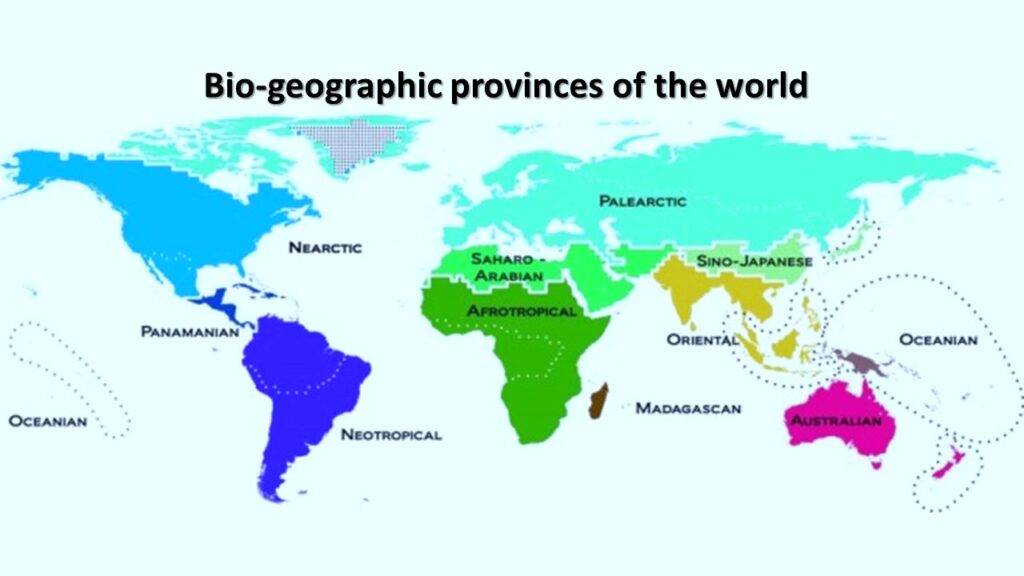
The unique distribution of global biodiversity across distinct biogeographic provinces of the world reflects the intricate history of evolutionary isolation, continental drift, and climatic zoning. Mastering these floral and faunal realms, along with their characteristic ecosystems, is crucial for UGC-NET/JRF, SLET, GATE, and other competitive examinations.
Use this curated MCQ bank to test your conceptual depth, identify weak areas, and sharpen your exam readiness.
Syllabus Outline
- Historical development and pioneers of Biogeography.
- Concepts of dispersal, migration, vicariance, and endemism.
- The role of geological events in shaping biogeographic patterns and the impact of environmental factors on species distribution.
- Definition and characteristics of biogeographic regions.
- Major biogeographic regions of the world (e.g., Nearctic, Palearctic, Neotropical, Afrotropical, Indomalayan, Australasian, and Antarctic).
- Boundaries and transitions between biogeographic regions.
- Factors influencing the delimitation of bio-geographic provinces.
- Examples of prominent biogeographic provinces and their unique characteristics.
- Species-area relationships and their significance in conservation.
- The role of bio-geographic provinces in conservation planning.
- Conservation hotspots and their conservation significance.
- Predicted biogeographic shifts and their ecological consequences.
Quick Study Guide
Biogeography maps the global distribution of plants and animals, explaining how Earth’s tectonic history and climatic shifts shape current biodiversity. Understanding these biogeographic provinces is essential for grasping the core principles of macroecology, evolutionary biology, and global conservation strategies.
- Global Biogeographic Realms: The Earth is divided into major evolutionary domains, such as the Palearctic, Neotropical, and Australasian realms. These regions are tied to ancient supercontinents like Gondwana and Laurasia, explaining why certain species are completely unique (endemic) to specific parts of the world.
- Vicariance and Dispersal: Species distribution is driven by two main processes. Vicariance occurs when physical changes in the Earth, like mountain formations or continental drift, split a population. Dispersal happens when species actively migrate across geographic barriers to colonise new environments.
- Biogeographic Boundaries: Invisible biological borders, most notably the Wallace Line, separate different groups of organisms. Deep ocean trenches and tectonic features maintain these rigid boundaries, preventing species from mixing even when geographic regions are close together.
- Climate and Climax Biomes: A region’s climate directly dictates its major ecosystems. Global temperature and precipitation patterns determine the dominant vegetation of each realm, such as the equatorial rainforests of the Afrotropical realm or the vast, cold taiga of the Palearctic realm.
- Floristic Provinces and Hotspots: Certain areas, like the California Floristic Province or the Mediterranean Basin, hold exceptional plant diversity. Shaped by unique local climates and geographic isolation, these zones act as ecological refuges that preserve highly specialised and rare species.
Test Your Knowledge
This quiz contains 25 concept-based MCQs on the Biogeographic provinces of the world. Each question has a single correct/most appropriate answer.
1. The Great Barrier Reef, the world’s largest coral reef system, is located in which biogeographic province?
a) Indo-Malay
b) Australasia
c) Nearctic
d) Neotropic
2. Assertion (A): The Palearctic biogeographic province has a diverse temperate flora and fauna in Europe, Asia, and North Africa.
Reasoning (R): The Palearctic region experiences wide temperature variations, with cold winters and hot summers, creating suitable conditions for temperate species.
a) A is true, but R is false.
b) A is false, but R is true.
c) Both A and R are true, and R is the correct explanation of A.
d) Both A and R are true, but R is not the correct explanation of A.
3. The Ethiopian Region is a biogeographic province located in ________.
a) Asia
b) South America
c) Europe
d) Africa
4. Which biogeographic province is known for its temperate rainforests, including the Great Bear Rainforest in Canada?
a) Neotropic
b) Indo-Malay
c) Nearctic
d) Palearctic
5. The Sahara Desert is part of which biogeographic province?
a) Indo-Malay
b) Nearctic
c) Palearctic
d) Afrotropic
6. The California Floristic Province is known for its exceptional plant diversity and is located in which biogeographic province?
a) Australasia
b) Nearctic
c) Neotropic
d) Palearctic
7. Which continents primarily cover the Mediterranean basin, characterised by a unique climate and vegetation?
a) Antarctica and Europe
b) Australia and Oceania
c) South America and North America
d) Europe, Africa, and Asia
8. Assertion (A): The Afrotropic biogeographic province is home to the Congo Basin, one of the world’s largest tropical rainforests.
Reasoning (R): The Afrotropic region includes Sub-Saharan Africa, where the Congo Basin is located, supporting diverse flora and fauna.
a) A is false, but R is true.
b) A is true, but R is false.
c) Both A and R are true, but R is not the correct explanation of A.
d) Both A and R are true, and R is the correct explanation of A.
9. The Amazon River flows through which biogeographic province?
a) Afrotropic
b) Neotropic
c) Nearctic
d) Australasia
10. The Holarctic is a biogeographic province that includes parts of which two continents?
a) Europe and Africa
b) Asia and Australia
c) North America and Europe
d) South America and Africa
11. Assertion (A): The Neotropic biogeographic province includes the Amazon Rainforest, the largest tropical rainforest in the world.
Reasoning (R): The Neotropic region encompasses Central and South America, including the Amazon Rainforest, which supports a wide range of biodiversity.
a) A is true, but R is false.
b) Both A and R are true, and R is the correct explanation of A.
c) Both A and R are true, but R is not the correct explanation of A.
d) A is false, but R is true.
12. Assertion (A): The Wallace Line separates two biogeographic provinces known for their distinct flora and fauna.
Reasoning (R): The Wallace Line is a transitional boundary between the islands of Bali and Lombok, marking the division between the Asian and Australian biogeographic provinces.
a) Both A and R are true, but R is not the correct explanation of A.
b) A is true, but R is false.
c) A is false, but R is true.
d) Both A and R are true, and R is the correct explanation of A.
13. The Sundaland bio-geographic province includes parts of which two regions?
a) South America and Africa
b) Southeast Asia and the Malay Archipelago
c) Asia and Europe
d) Australia and Oceania
14. The Great Victoria Desert is located in which biogeographic province?
a) Afrotropic
b) Australasia
c) Nearctic
d) Indo-Malay
15. The Great Dividing Range is a mountain range found in which biogeographic province?
a) Nearctic
b) Australasia
c) Palearctic
d) Indo-Malay
16. The Wallace Line separates two biogeographic provinces known for their distinct flora and fauna. Which are these two provinces?
a) Nearctic and Neotropic
b) Palearctic and Indo-Malay
c) Indo-Malay and Australasia
d) Neotropics and Australasia
17. Assertion (A): The Indo-Malay bio-geographic province is known for its high species diversity and includes the Sundaland region.
Reasoning (R): The Indo-Malay province encompasses Southeast Asia, parts of the Indian subcontinent, and the Malay Archipelago, which are rich in biodiversity.
a) Both A and R are true, and R is the correct explanation of A.
b) A is false, but R is true.
c) A is true, but R is false.
d) Both A and R are true, but R is not the correct explanation of A.
18. The Madrean Pine-Oak Woodlands, a biogeographic province, is mainly found in which regions?
a) North America and South America
b) Africa and Antarctica
c) Australia and Oceania
d) Europe and Asia
19. The Thar Desert, also known as the Great Indian Desert, is part of which biogeographic province?
a) Palearctic
b) Indo-Malay
c) Nearctic
d) Australasia
20. The Sonoran Desert, one of the hottest deserts in North America, is primarily located in which biogeographic province?
a) Afrotropic
b) Neotropic
c) Nearctic
d) Indo-Malay
21. The Gulf of California is a characteristic feature of which biogeographic province?
a) Australasia
b) Neotropic
c) Indo-Malay
d) Nearctic
22. The Siberian Taiga is a vast forested region found in which biogeographic province?
a) Neotropic
b) Nearctic
c) Indo-Malay
d) Palearctic
23. The Mediterranean Basin biogeographic province is known for its Mediterranean climate. Which countries border the Mediterranean Sea?
a) Australia and New Zealand
b) Turkey and Egypt
c) Spain and Portugal
d) Italy and Greece
24. Which biogeographic province includes the Himalayan mountain range and is known for its rich plant and animal diversity?
a) Australasia
b) Nearctic
c) Indo-Malay
d) Palearctic
25. The Gondwana biogeographic province was named after the ancient supercontinent. In which modern-day continent was this supercontinent primarily located?
a) Antarctica
b) Australia
c) South America
d) Africa
Previous: Resources and their assessment
Next: Agro-climatic zones of India
References
- Edward O. Wilson (2010). The Diversity of Life, Harvard University Press, 1st edition.
- H.M. Saxena (2017). Environmental Geography, Rawat Publications, 3rd edition.
- Erach Bharucha (2017). Environmental Studies, Universities Press, 4th edition.
🔗 Explore More MCQs: