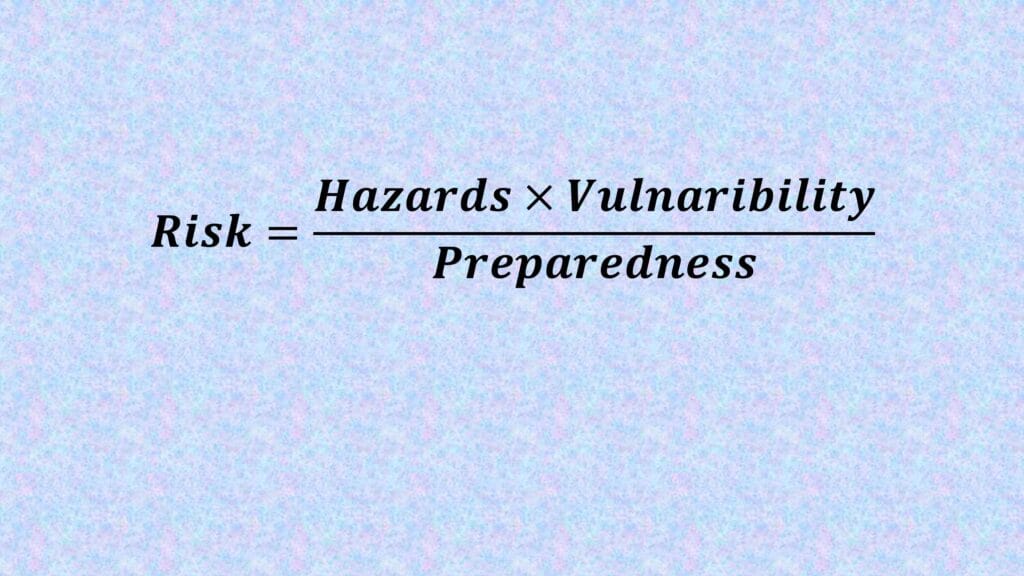
How can potential environmental threats be identified and managed before they cause significant harm to ecosystems and human health? Environmental Risk Assessment and Management provides the scientific framework for evaluating hazards, estimating risks, and developing strategies to prevent, reduce, or control adverse environmental impacts. From industrial activities and chemical releases to natural disasters and emerging environmental challenges, risk-based approaches play a critical role in informed decision-making and sustainable environmental management. Mastering these concepts is essential for understanding environmental protection strategies and for success in UGC-NET/JRF, SLET, ARS, GATE, and other competitive examinations.
Use this curated MCQ bank to assess your conceptual understanding, identify knowledge gaps, and strengthen your preparation for competitive examinations.
Syllabus Outline
- Fundamental concepts of risk, hazard, and vulnerability.
- Principles and frameworks for environmental risk assessment and management.
- Methodologies for hazard identification, exposure assessment, and risk characterisation.
- Ecological and human health risk assessment, climate change risks, and industrial hazards.
- Integration of risk assessment in EIA, national and international policies, governance frameworks, and SDGs
Quick Study Guide
A. Hazard vs. Risk:
- Hazard: The intrinsic ability of something to cause harm (e.g., lead is toxic, gasoline is explosive).
- Risk: The probability that harm will actually happen. It depends entirely on whether you are exposed to the hazard.
Risk = f (Hazard x Exposure)
B. The 4 Steps of Risk Assessment
- Hazard Identification (What is the pollutant?): Determines if a chemical is linked to specific health problems (e.g., identifying that benzene causes leukaemia).
- Dose-Response Assessment (How toxic is it?): Finds the mathematical relationship between the amount of chemical received (dose) and its health effects (response).
- Exposure Assessment (Who is exposed and how much?): Estimates how long, how often, and through what pathways (breathing, drinking, eating, or skin contact) people encounter the pollutant.
- Risk Characterisation (What is the final probability of harm?): Combines data from the first three steps to calculate the overall risk level and address data uncertainties.
C. Understanding Dose-Response Curves
- NOAEL (No Observed Adverse Effect Level): The highest dose tested where zero harmful effects are seen.
- LOAEL (Lowest Observed Adverse Effect Level): The lowest dose tested where harmful effects first start to show up.
- Reference Dose (RfD): The safe daily dose for humans over a lifetime. It is calculated by dividing the NOAEL by uncertainty factors (safety margins).
D. How Risk is Counted?
- Non-Carcinogens (Threshold Chemicals): These assume your body can handle small amounts safely up to a point. Safety is measured by the Hazard Quotient (HQ):
HQ = Average Daily Dose / Reference Dose
HQ ≤ 1: Safe. The dose is below the toxic threshold.
HQ > 1: Dangerous. Potential health risks require action.
2. Carcinogens (Non-Threshold Chemicals): These assume that even a single molecule could potentially trigger cancer. It is measured by the Incremental Lifetime Cancer Risk (ILCR):
ILCR = Lifetime Average Daily Dose times x Slope Factor
E. Management vs. Communication
- Risk Management: The actual decision-making step. It balances science against financial costs and engineering limits to pass regulations (like setting legal limits for lead in tap water).
- Risk Communication: Shuffling information clearly between scientists, politicians, and the public to build trust and stop panic during an environmental crisis.
Test Your Knowledge
This quiz contains 25 concept-based MCQs on “Environmental Risk Assessment and Management“. Each question has a single correct/most appropriate answer.
*****
1. What is the purpose of conducting a HAZOP study in industrial settings?
a) To assess financial risks
b) To identify potential hazards and operability issues
c) To improve employee morale
d) To increase production speed
2. What international standard is used for improving safe working conditions?
a) ISO 9001
b) OHSAS 18001
c) ISO 14001
d) ISO 45001
3. What does DMP stand for in disaster management?
a) Disaster Mitigation Protocol
b) Disaster Management Procedure
c) Disaster Monitoring Plan
d) Disaster Management Plan
4. What is the purpose of the Risk Potential calculation?
a) To estimate financial losses
b) To prioritise necessary actions for risk management
c) To determine the risk level of employees
d) To assess the environmental impact of a process or product
5. Which risk rating indicates a catastrophic event with casualties and disastrous environmental damage?
a) 1
b) 2
c) 4
d) 5
6. What type of risk assessment method may be required to determine suitable control measures?
a) Qualitative risk assessment
b) Quantitative risk assessment
c) Preliminary risk assessment
d) Comparative risk assessment
7. What mitigation measure is recommended for a fire at a coal stockyard?
a) Installation of CO detectors
b) Provision of acid-resistant PPE
c) Firefighting system with alarm
d) Adoption of control measures
8. What type of hazard is associated with the emission of VOC, dioxin, and furan?
a) Fire hazard
b) Health hazard
c) Environmental hazard
d) Financial hazard
9. What is the purpose of the Fault Tree Analysis?
a) To assess financial risks
b) To identify potential hazards
c) To reduce employee fault
d) To increase production speed
10. What is the primary responsibility of the Rescue Team Leader in case of an emergency?
a) Consult with the Safety In-Charge
b) Inform the Work Management Committee
c) Organise the Rescue Team
d) Shift injured persons to the hospital
11. What is the first step in conducting an Environmental Risk Assessment?
a) Risk characterisation
b) Exposure assessment
c) Hazard identification
d) Risk management
12. What is a common method used for risk characterisation in Environmental Risk Assessment?
a) Life cycle assessment
b) Cost-benefit analysis
c) Probabilistic risk assessment
d) SWOT analysis
13. What does the term acceptable risk refer to?
a) The highest level of risk that can be tolerated without any management action.
b) A level of risk that is deemed acceptable by regulatory agencies.
c) The lowest possible level of risk.
d) A risk level at the coping capacity of the management authority.
14. Which of the following is an example of a qualitative risk assessment method?
a) Monte Carlo simulation
b) Fault tree analysis
c) Expert judgment
d) Dose-response modelling
15. Which of the following is a key component of a health risk assessment?
a) Environmental impact assessment
b) Dose-response assessment
c) Life cycle assessment
d) Employee health review
16. Which of the following is an example of a quantitative risk assessment method?
a) Expert judgment
b) Risk matrix
c) Monte Carlo simulation
d) SWOT analysis
17. Risk is directly proportional to
I – Hazards
II – Vulnerability
III – Preparedness
a) I only
b) I and II
c) I, II and II
d) II only
18. The susceptibility of an individual is a function of ________.
a) Age
b) Toxin
c) Carcinogen
d) Mutagen
19. Which of the following is an example of a climatological disaster?
a) Cold wave
b) Heatwave
c) Drought
d) Tsunami
20. Which of the following is not true for disaster vulnerability?
a) An increase in hazard proximity increases vulnerability
b) Vulnerability is an attribute only assessed for living beings
c) With improved preparedness, vulnerability can be reduced
d) The magnitude of the hazard can largely influence vulnerability
21. _______ is a factor closely related to the social vulnerability of the human community.
a) Geo-environment
b) Violence
c) Employment opportunities
d) Taxation pattern
22. For an efficient disaster mitigation plan, _____ is the first step towards planning.
a) Hazard Indemnification
b) Risk Assessment
c) Emergency Response
d) Rescue and Relief operations
23. For disaster mitigation across the nation, as per the Disaster (Management) Act, 2005, ___________ is the apex agency at the national level which has been entrusted with the mitigation activities.
a) Natural Disaster Management Agency
b) Natural Disaster Management Authority
c) National Disaster Management Agency
d) National Disaster Management Authority
24. Which of the following is a technological necessity of a Disaster Management Plan?
a) Compliance with the statute
b) Reduce human suffering
c) Early warning system for Disaster
d) Relief fund
25. The plan of action to be followed to minimise the harmful effects of people living in the surrounding areas outside the boundary of the industry is called:
a) Offsite emergency plan
b) On-site Emergency plan
c) Evacuation plan
d) Disaster Management plan
*****
Previous: Environmental Management System
Next: Environmental Laws in India
References
- Smith, K. (2013). Environmental Hazards: Assessing Risk and Reducing Disaster, Routledge, 6th Edition.
- Ministry of Environment, Forest and Climate Change (2006). EIA Notification 2006 and Amendments. Government of India
- M. Anji Reddy (2026). Environmental Impact Assessment: Theory and Practice, BS Publications, 1st Edition.
- Erach Bharucha (2017). Environmental Studies, Universities Press, 4th Edition.
- Singh, J.S., Gupta, S.R., Singh, S.P. & Singh, R. (2026). Ecology, Environmental Science and Conservation, S Chand Publishing, 2nd Edition.
🔗 Explore More MCQs: