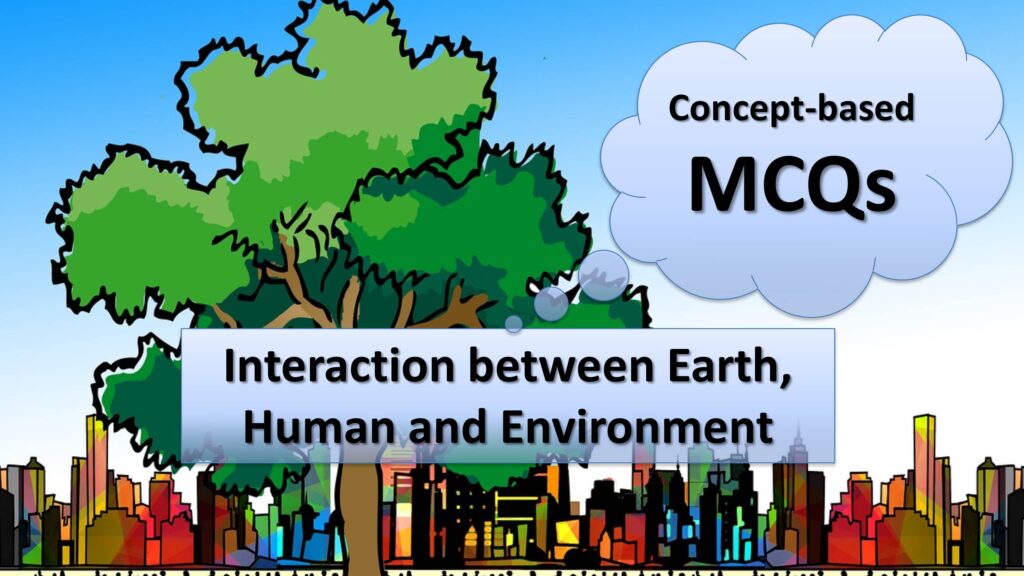
The dynamic interaction between humans and the environment shapes global ecosystems, drives anthropogenic environmental changes, and dictates sustainability pathways. Understanding these complex ecological relationships, resource consumption patterns, and human impacts is crucial for UGC-NET/JRF, SLET, ARS, GATE, and other competitive examinations.
Use this curated MCQ bank to test your conceptual depth, identify weak areas, and sharpen your exam readiness.
Syllabus outline
- Definition and scope of the interaction between Earth, humans, and the environment.
- Historical perspectives on human-environment relationships.
- Importance of studying this interaction for sustainable development.
- Anthropogenic activities and their environmental consequences (e.g., deforestation, urbanisation, industrialisation, pollution, and climate change).
- Exploration of ethical frameworks and values that influence human interactions with the environment.
- The role of culture, society, and religion in shaping attitudes towards nature and sustainability.
- Ecosystem Services (e.g., provisioning, regulating, cultural, and supporting services) and their importance for human well-being.
- Valuation of ecosystem services in decision-making processes.
- The impact of climate change on human societies, economies, and ecosystems.
- Strategies for climate change adaptation and mitigation.
- Concepts and indicators of sustainable development and the role of international agreements and policies in promoting sustainability.
- Population dynamics and its influence on resource consumption and environmental degradation.
- Family planning and population policies.
- The importance of environmental education in promoting responsible behaviour and sustainable practices.
- Natural disasters and their impact on human and environmental systems.
Quick Study Guide
The interaction between humans and the environment examines the dynamic relationship between human societies and Earth’s natural systems. In Environmental Science, an interdisciplinary field integrating ecology, economics, sociology, ethics, climatology, and sustainability studies, researchers examine how anthropogenic activities influence environmental quality and resource availability. A conceptual understanding of human–environment interactions is essential for analysing environmental degradation, ecosystem services, climate change, sustainable development, and environmental governance.
- Human–Environment Relationship and Anthropogenic Activities: Human societies depend on natural resources for energy, food, shelter, and economic development. Activities such as deforestation, industrialisation, urbanisation, mining, and intensive agriculture significantly alter ecosystems and biogeochemical cycles, leading to pollution, biodiversity loss, and climate change.
- Environmental Ethics and Sustainability: Environmental ethics examines moral responsibilities toward nature and future generations. Concepts such as sustainable development, environmental justice, ecological footprint, and the tragedy of the commons highlight the need for equitable and sustainable resource management.
- Ecosystem Services and Human Well-being: Ecosystems provide provisioning, regulating, supporting, and cultural services essential for human survival and economic stability. Valuation of ecosystem services plays an important role in environmental policy, conservation planning, and sustainable decision-making.
- Climate Change and Human Societies: Anthropogenic greenhouse gas emissions have intensified global warming and extreme weather events. Climate change affects agriculture, water resources, public health, economies, and ecosystems. Adaptation and mitigation strategies are central components of global environmental governance.
- Population, Environmental Education, and Disaster Management: Population growth increases resource consumption, waste generation, and environmental stress. Environmental education promotes sustainable behaviour and ecological awareness. Natural disasters such as floods, cyclones, droughts, and earthquakes disrupt both environmental and human systems, highlighting the importance of disaster preparedness and resilience.
Test Your Knowledge
This quiz contains the most frequently asked 25 concept-based MCQs on “Interaction between Earth, Humans, and Environment”. Each question has a single correct/most appropriate answer.
1. The concept of ecological footprint refers to:
a) The total land area required to sustain a given population’s resource consumption
b) The amount of carbon dioxide emitted by an individual or organisation
c) The rate of species extinction in a particular ecosystem
d) The availability of freshwater resources in a region
2. The Kuznets curve suggests that:
a) Economic development leads to environmental degradation initially, but eventually results in improvement
b) Environmental protection is prioritised over economic growth in developed countries
c) Environmental sustainability can be achieved through technological advancements alone
d) Economic inequality is positively correlated with environmental degradation
3. The tragedy of the commons refers to:
a) The equitable distribution of resources among different social groups
b) The depletion of shared resources due to individual self-interest
c) The overregulation of natural resource extraction by government authorities
d) The concept of communal ownership and management of natural resources
4. The circular economy is an economic model that promotes:
a) Linear resource consumption and disposal
b) Integration of environmental and social considerations in economic decision-making
c) Unlimited economic growth through technological advancements
d) Extraction and depletion of natural resources
5. The concept of environmental justice primarily focuses on:
a) Promoting sustainable development practices
b) Ensuring equal access to natural resources
c) Protecting endangered species
d) Mitigating the impacts of climate change
6. The Intergovernmental Panel on Climate Change (IPCC) is an international body that:
a) Conducts scientific research on climate change impacts and mitigation strategies
b) Coordinates global efforts to adapt to climate change and reduce vulnerability
c) Advocates for climate justice and environmental equity
d) Negotiate international agreements to reduce greenhouse gas emissions
7. The concept of planetary boundaries suggests that:
a) Economic growth can be decoupled from resource consumption and environmental impacts
b) Technological advancements can overcome environmental constraints
c) Human activities should not exceed the limits of Earth’s carrying capacity
d) The responsibility for addressing global environmental issues lies with individual nations
8. Assertion (A): Climate change can increase the frequency and intensity of extreme weather events.
Reasoning (R): Rising global temperatures alter atmospheric patterns, resulting in more frequent and severe storms, droughts, and heat waves.
a) Both A and R are true, but R is NOT a correct explanation of A.
b) A is true, but R is false.
c) A is false, but R is true.
d) Both A and R are true, and R is a correct explanation of A.
9. Which of the following is an example of a tele-coupling in the context of global environmental change?
a) The spread of infectious diseases across international borders
b) The trade of goods and resources between different countries
c) International cooperation to address climate change through the Paris Agreement
d) The migration of individuals due to changing environmental conditions
10. The concept of environmental governance refers to:
a) Individual actions to reduce personal carbon footprints
b) The legal framework and institutions that regulate environmental issues
c) Public participation in environmental decision-making processes
d) The process of international cooperation on climate change mitigation
11. The concept of sustainable consumption promotes:
a) Reduction of personal carbon footprints
b) Conservation and efficient use of resources
c) Increased reliance on renewable energy sources
d) Preservation of wilderness areas and biodiversity hotspots
12. Which of the following is a consequence of biological invasions?
a) Increased species diversity and ecosystem resilience
b) Expansion of native species’ ranges due to new ecological niches
c) Displacement and extinction of native species
d) Enhanced ecosystem services provided by introduced species
13. The concept of carrying capacity refers to:
a) The degree of biodiversity within a community
b) The maximum population size that an environment can sustain indefinitely
c) The rate at which species adapt to changing environmental conditions
d) The total amount of resources available in an ecosystem
14. The term carbon footprint refers to:
a) The rate of carbon dioxide absorption by the oceans
b) The amount of carbon stored in an ecosystem
c) The total amount of greenhouse gases emitted by an individual or organisation
d) The amount of carbon dioxide released during photosynthesis
15. Assertion (A): Desertification is primarily caused by human activities, such as deforestation and overgrazing.
Reasoning (R): Unsustainable land management practices lead to soil degradation and the expansion of arid and semi-arid regions.
a) Both the A and R are true, and the R is a correct explanation of the A.
b) The A is true, but the R is false.
c) The A is false, but the R is true.
d) Both the A and R are true, but the R is NOT a correct explanation of the A.
16. Which of the following is an example of a tipping point in an ecosystem?
a) Gradual migration of bird species due to climate change
b) Rapid recovery of coral reefs after a bleaching event
c) Long-term adaptation of plant species to changing environmental conditions
d) Sudden collapse of fish populations in a marine ecosystem
17. The Great Pacific Garbage Patch is a large area in the Pacific Ocean where:
a) Plastic debris accumulates due to ocean currents
b) Toxic algae blooms occur due to nutrient pollution
c) Oil spills have caused significant environmental damage
d) Deep-sea mining activities have disrupted ecosystems
18. Assertion (A): Overfishing can disrupt marine food webs and lead to ecological imbalances.
Reasoning (R): Removal of the top predator fish species can cause an increase in their prey populations, which affects the entire food chain.
a) Both the A and R are true, and the R is a correct explanation of the A.
b) The A is true, but the R is false.
c) The A is false, but the R is true.
d) Both the A and R are true, but the R is NOT a correct explanation of the A.
19. Which of the following is an example of environmental refugees?
a) Communities affected by industrial pollution and hazardous waste
b) Indigenous populations defending their traditional lands against resource extraction
c) Individuals seeking economic opportunities in urban areas
d) People displaced by natural disasters, such as hurricanes or earthquakes
20. The precautionary principle suggests that:
a) Environmental decisions should be based on economic cost-benefit analyses
b) Environmental policies should prioritise economic growth over ecological concerns
c) Scientific evidence is necessary before taking action to address potential environmental risks
d) It is better to take preventive measures to avoid potential environmental harm even in the absence of complete scientific certainty
21. Assertion (A): Environmental sustainability requires a shift from a linear economy to a circular economy.
Reasoning (R): A circular economy aims to reduce waste, maximise resource efficiency, and promote reuse, recycling, and regeneration of materials.
a) Both A and R are true, and R is a correct explanation of A.
b) Both A and R are true, but R is NOT a correct explanation of A.
c) A is true, but R is false.
d) A is false, but R is true.
22. Which of the following is an example of greenwashing?
a) A company promoting its use of renewable energy sources
b) A corporation falsely claiming its products are environmentally friendly
c) A government implementing policies to reduce greenhouse gas emissions
d) An environmental organisation advocating for sustainable development
23. Which of the following is an example of urban sprawl?
a) Preservation of green spaces and parks within cities
b) Expansion of public transportation systems to reduce car usage
c) Concentration of population and economic activities in urban areas
d) Unplanned and uncontrolled growth of urban areas into surrounding undeveloped land
24. Which of the following is a consequence of global climate change?
a) Decreased sea level rise
b) Expansion of polar ice caps
c) Increased frequency of extreme weather events
d) Decreased agricultural productivity
25. The Anthropocene refers to:
a) The era of rapid technological advancements in human history
b) A geological epoch marked by human influence on the Earth’s ecosystems
c) The concept of human domination over nature
d) The study of ancient human civilisations
Previous: Meteorological parameters
Next: Resources and their assessment
References
- Erach Bharucha (2017). Environmental Studies, Universities Press, 4th edition
- Jay H Withgott and Matthew Laposata (2015). Environment: The Science behind the Stories, Pearson, 5th edition
- Rajagopalan R. (2015). Environmental Studies from Crisis to Cure, Oxford University Press, 3rd edition.
🔗 Explore More MCQs: