Why are certain elements concentrated in the Earth’s crust while others are commonly found in the atmosphere, hydrosphere, or core? Geochemical Classification of Elements provides the framework for understanding how elements are distributed within different Earth systems based on their chemical properties and geochemical behaviour. These principles are fundamental to interpreting elemental cycles, mineral formation, resource distribution, and environmental processes. Mastering these concepts is essential for UGC-NET/JRF, SLET, ARS, GATE, and other competitive examinations.
Use this curated MCQ bank to assess your conceptual understanding, identify knowledge gaps, and strengthen your preparation for competitive examinations.
Syllabus Outline
- Introduction to geochemical classification (e.g. major elements, trace elements, rare earth elements, and isotopes).
- Characteristics and classification of elements (e.g. lithophile, atmophile, chalcophile, siderophile, and biophilic).
- Composition and distribution of major elements in Earth’s crust.
- Role of silicate minerals in major element classification and the environmental significance of oxides, carbonates and sulfides.
- Behaviour and distribution of trace and rare Earth elements in geological systems.
- Factors influencing mobility and concentration of elements.
- Principles and applications of isotope geochemistry.
- Geochemical modelling and ethical considerations in environmental geochemistry.
Quick Study Guide
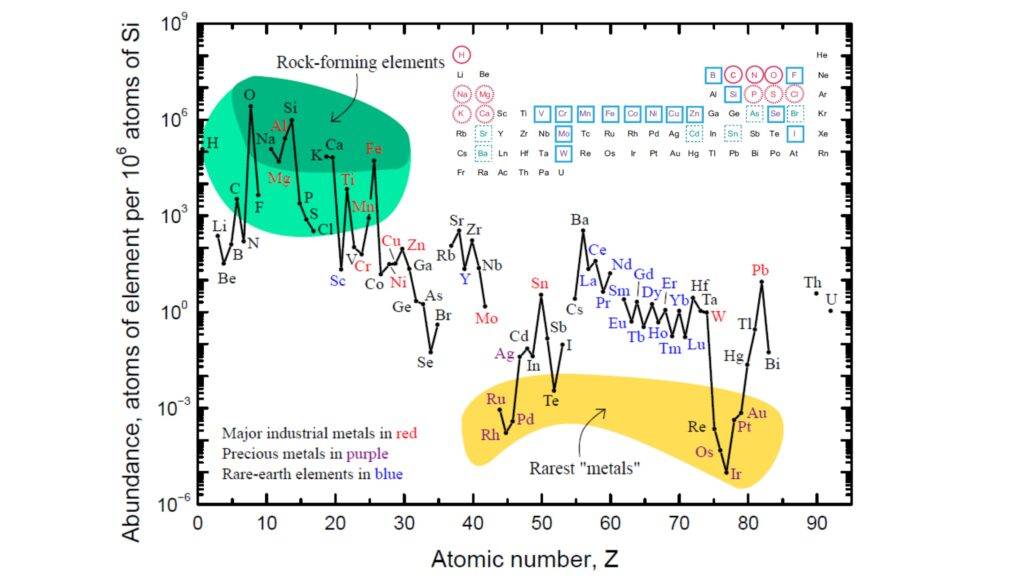
The geochemical classification of elements categorises chemical species based on their preferred chemical affinities and partitioning behaviour within planetary systems. Originally established by Victor Goldschmidt, this framework explains how elements segregate into Earth’s core, mantle, crust, atmosphere, and hydrosphere based on their electronic configurations, bonding preferences, and thermodynamic stability.
- Lithophile Elements: These elements (e.g., Al, Mg, K, Na, Ca, Si) possess a strong affinity for oxygen and bond ionically to form silicate minerals. Because of this preference, they concentrated heavily in the silicate melt during planetary differentiation, forming the bulk of Earth’s crust and mantle.
- Siderophile Elements: These “iron-loving” elements (e.g., Fe, Ni, Co, and Platinum-Group Elements like Pt and Ir) have high metallic affinities. Due to their outer electronic structures, they preferentially dissolved into metallic iron and sank to form Earth’s dense core during early planetary differentiation.
- Chalcophile Elements: These “sulfur-loving” elements (e.g., Cu, Zn, Pb, Cd, As) show a strong affinity for sulfur, selenium, and arsenic, readily forming covalent bonds. They preferentially concentrate in sulfide mineral phases and dominate hydrothermal ore deposits within the crust and upper mantle.
- Atmophile Elements: These volatile elements (e.g., H, N, C, and noble gases like He, Ne, Ar) exist predominantly in uncombined or gaseous forms. Due to their high volatility, they partitioned almost entirely into the atmosphere and hydrosphere during planetary degassing.
- Goldschmidt’s Substitution Rules: The distribution of trace elements within minerals is governed by their ionic radius and ionic charge. Ions can mutually substitute within a crystal lattice if their radii differ by less than 15%. If charges match, it is termed camouflage. If an ion has a higher valence or smaller radius, it exhibits a higher ionic potential (z/r, where z is charge and r is radius) and is preferentially captured by the lattice, whereas weaker ions are admitted.
- Compatibility and Melts: Elements are classified by their partition coefficient during magmatic processes. Compatible elements fit easily into mineral lattices, while incompatible elements are excluded due to mismatched size or charge, concentrating in residual fluids. Incompatible elements are subdivided into Large-Ion Lithophile Elements (e.g., Rb, Cs), which have low ionic potential, and High-Field-Strength Elements (e.g., Zr, Th, Hf), which possess high ionic charges.
Test Your Knowledge
This quiz contains 25 concept-based MCQs on “Geochemical Classification of Elements“. Each question has a single correct/most appropriate answer.
*****
1. Chalcophile elements are separated below lithophile elements during:
a) Crystallisation of the Earth’s core
b) Volcanic eruptions
c) Differentiation of the Earth’s crust
d) Formation of the mantle
2. Which geochemical classification includes elements having a strong affinity for combining with oxygen?
a) Lithophile
b) Siderophile
c) Atmophile
d) Chalcophile
3. The partitioning of elements between minerals and melts during crystallisation is governed by which principle?
a) Raoult’s Law
b) Bowen’s Reaction Series
c) Goldschmidt’s Rules
d) Hess’s Law
4. Which elements are classified as organophiles due to their association with organic compounds in biochemical and biogeochemical processes?
a) C, H, N
b) Cu, Pb, Zn
c) Re, Os, W
d) Be, Mg, Si
5. The distribution of which element is often used to trace the extent of hydrothermal alteration in mineral deposits?
a) Zinc
b) Copper
c) Sodium
d) Lead
6. The bioaccumulation concept of elements in aquatic ecosystems primarily refers to the accumulation of which type of elements?
a) Noble Gases
b) Halogens
c) Transition Metals
d) Alkaline Earth Metals
7. Which elements in Goldschmidt’s classification are preferentially partitioned into silicate minerals?
a) Atmophile
b) Lithophile
c) Chalcophile
d) Siderophile
8. Lithophile elements are concentrated in which portion of the Earth?
a) Mantle
b) Hydrosphere
c) Crust
d) Core
9. Lithophile elements are difficult to reduce to the elementary state due to their strong affinity for:
a) Sulfur
b) Carbon
c) Oxygen
d) Nitrogen
10. Which of the following elements is typically classified as a trace element in geochemistry?
a) Zinc
b) Silicon
c) Calcium
d) Iron
11. Which group of elements is depleted in the silicate portion of the Earth and concentrated in the metallic core?
a) Atmophile
b) Lithophile
c) Chalcophile
d) Siderophile
12. What is the primary control on the distribution of rare earth elements in geological systems?
a) Weathering processes
b) Temperature gradients
c) Organic matter content
d) Crystal structure
13. Which classification system is primarily used to describe the temperature interval over which elements condense from a gaseous state to a solid or liquid state during nebular condensation and planetary accretion?
a) Metallic Behaviour Classifications
b) Cosmochemical Classifications
c) Refractory Classifications
d) Partitioning Classifications
14. What is used to describe elements that tend to accumulate in the Earth’s core due to their high density?
a) Chalcophile
b) Lithophile
c) Atmophile
d) Siderophile
15. Which of the following elements is commonly associated with the formation of acid mine drainage?
a) Titanium
b) Chromium
c) Iron
d) Nickel
16. Which element is proposed as a biophile element in the recent study but not traditionally classified as such?
a) Copper
b) Zinc
c) Arsenic
d) Iron
17. Which element is commonly used as a redox condition indicator in the Earth’s crust?
a) Potassium
b) Calcium
c) Sodium
d) Manganese
18. The isotopic fractionation concept in geochemistry refers to the preferential partitioning of isotopes of which element during physical or chemical processes.
a) Carbon
b) Oxygen
c) Hydrogen
d) Nitrogen
19. The concept of compatibility of elements in mineral structures is primarily based on their relative abundance in which geological feature?
a) Igneous rocks
b) Metamorphic rocks
c) Hydrothermal veins
d) Sedimentary rocks
20. Goldschmidt classification is primarily based on the affinity of elements for which of the following?
a) Volcanic eruptions
b) Formation of minerals
c) Atmospheric composition
d) Biological processes
21. Which classification includes elements that can be lithophile, organophile, chalcophile, and siderophile, depending on oxidation state and chemical environment?
a) Partitioning Classifications
b) Cosmochemical Classifications
c) Metallic Behaviour Classifications
d) Refractory Classifications
22. Which classification includes elements that commonly form sulfide-type minerals?
a) Chalcophile
b) Siderophile
c) Organophile
d) Atmophile
23. Which classification includes elements that readily form volatile compounds at relatively low temperatures and are preferentially concentrated in planetary atmospheres?
a) Siderophile
b) Atmophile
c) Chalcophile
d) Organophile
24. Which element is considered a major component of the Earth’s crust and is abundant in silicate minerals?
a) Carbon
b) Aluminum
c) Sodium
d) Oxygen
25. The elements that are preferentially partitioned into the metallic core are known as:
a) Siderophile
b) Chalcophile
c) Atmophile
d) Lithophile
*****
Previous: Earth’s Thermal Environment and Seasons
Next: Hydrogeology and Hydrology
References
- Edward A. Keller (2022). Introduction to Environmental Geology, Pearson, 5th Edition.
- Sharma, P. D. (2017). Environmental Biology and Toxicology, Rastogi Publications, 3rd Edition.
- De, Anil Kumar and De, Arnab Kumar (2024). Environmental Chemistry, New Age International, 11th Edition.
- Odum, Eugene P., and Barrett, Gary W. (2004). Fundamentals of Ecology, Thomson Brooks/Cole, 5th Edition.
- Singh, J.S., Gupta, S.R., Singh, S.P. & Singh, R. (2026). Ecology, Environmental Science and Conservation, S Chand Publishing, 2nd Edition.
- Erach Bharucha (2017). Environmental Studies, Universities Press, 4th Edition.
🔗 Explore More MCQs: