COMPETITIVE EXAM MCQs SERIES of LIFE SCIENCES for CSIR-UGC NET/JRF, SLET, GATE, and other entrance tests – CELLULAR ORGANIZATION – Cell Membrane Structure and Function.
Syllabus Outline
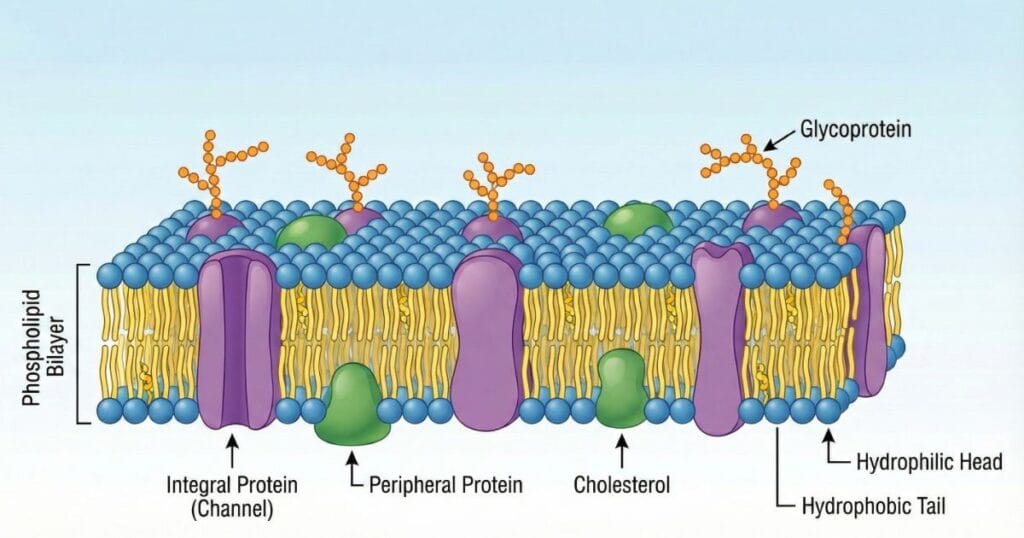
- Structure of model membrane, lipid bilayer and membrane protein diffusion.
- Osmosis, ion channels, active transport and membrane pumps.
- Mechanism of sorting and regulation of intracellular transport.
- Electrical properties of membranes and functions
This quiz contains concept-based, most frequently asked 25 MCQs of “CELLULAR ORGANIZATION – Cell Membrane Structure and Function”. Each question has a single correct/most appropriate answer.
*****
1. When membranes are treated with cold Triton X-100, the “raft” fraction stays insoluble. Which composition best defines this detergent-resistant fraction?
A) High in phosphatidylcholine, arachidonic acid, and transferrin receptors.
B) High in cardiolipin, dolichol, and cytochrome c oxidase.
C) High in phosphatidylserine, phosphatidylethanolamine, and clathrin.
D) High in sphingomyelin, cholesterol, and GPI-anchored proteins.
2. A graph shows the initial glucose uptake rate vs the external glucose concentration. Curve A is linear. Curve B is hyperbolic. Which is correct?
A) Curve A is non-saturable; Curve B is simple diffusion.
B) Curve A is simple diffusion; Curve B is carrier-mediated transport that saturates.
C) Both are active transport; Curve B is a symporter; Curve A is an antiporter.
D) Curve B is aquaporin transport, which saturates quickly.
3. Which statement correctly describes the Na⁺/K⁺ pump cycle and vanadate inhibition?
A) The pump adds phosphate to an aspartate residue; vanadate mimics phosphate
B) The pump binds 3 Na⁺ and 2 K⁺ together on the inside; vanadate competes with K⁺.
C) ATP breakdown occurs in the E₂ state; vanadate prevents ADP release.
D) The pump creates proton-motive force; vanadate collapses the proton gradient.
4. Aquaporins transport water rapidly while blocking protons. Which structural feature prevents proton passage?
A) Two conserved asparagine residues act as a size filter.
B) Electrical repulsion from arginine clusters at the pore entrance.
C) Water reorientation by a dual NPA motif prevents the formation of a proton wire
D) Hydrophobic phenylalanine constriction physically blocks the larger hydronium ion.
5. A neuron has internal K⁺ = 140 mM and external K⁺ = 5 mM. If the temperature rises from 20°C to 37°C, what happens to the potassium equilibrium potential (Eₖ)?
A) Eₖ becomes more negative (hyperpolarised).
B) Eₖ becomes less negative (depolarised).
C) Eₖ stays the same.
D) Eₖ flips to positive.
6. Single-channel recording of an acetylcholine receptor shows flickering between open/closed. When holding voltage changes from -60 mV to -120 mV, current doubles (from -2 pA to -4 pA). What does this show?
A) Single-channel conductance is constant and follows Ohm’s law.
B) Channel opening is voltage-dependent.
C) The channel is blocked by magnesium in a voltage-dependent way.
D) The channel is selective for negative ions.
7. Why can’t a second action potential be generated during the absolute refractory period?
A) K⁺ channels are still open, causing massive hyperpolarisation.
B) Voltage-gated Na⁺ channels are in the inactivated state.
C) The Na⁺/K⁺ pump has used up all ATP.
D) The threshold potential has shifted to +50 mV.
8. The lipid bilayer acts electrically as a:
A) Resistor
B) Inductor
C) Battery
D) Capacitor
9. In polarised epithelial cells, what prevents membrane proteins from diffusing from the top (apical) to the bottom (basolateral)?
A) Gap junctions
B) Desmosomes
C) Tight junctions
D) Hemidesmosomes
10. A father with Leber’s Hereditary Optic Neuropathy (LHON) caused by mitochondrial mutation has children with a healthy mother. What’s the probability their children will have LHON?
A) 100%
B) 50%
C) 25%
D) 0%
11. The Na⁺/K⁺ pump is electrogenic (3 Na⁺ out, 2 K⁺ in). How much does this pump directly contribute to the resting membrane potential of -70 mV?
A) It generates the entire -70 mV.
B) It contributes about -5 to -10 mV
C) It makes the potential positive.
D) It sets up gradients, but the passive K⁺ diffusion contributes to the resting membrane potential of -70 mV
12. The Na⁺/glucose transporter couples 2 Na⁺ ions to 1 glucose molecule. Why are 2 Na⁺ ions needed?
A) To balance the charge of glucose.
B) To provide energy to accumulate glucose.
C) To prevent glucose from leaking back.
D) It’s a random accident.
13. During membrane fusion, the “hemifusion” intermediate means:
A) Fusion of the half membrane of the two adjacent membranes.
B) Fusion of the outer layers of the two membranes.
C) Fusion of the inner layers only.
D) Formation of a protein pore without lipid mixing.
14. The signal sequence for the mitochondrial matrix is usually:
A) An amphipathic alpha-helix at the N-terminus.
B) A hydrophobic stretch at the C-terminus.
C) A KDEL motif.
D) A mannose-6-phosphate tag.
15. Yeast Two-Hybrid for studying protein-protein interactions works by:
A) Rebuilding a functional transcription factor from split DNA-binding and activation parts.
B) FRET between two fluorophores.
C) Co-immunoprecipitation.
D) Fixing a Sec mutant.
16. “Dynamic instability” of microtubules is driven by:
A) ATP breakdown by tubulin.
B) GTP breakdown by the beta-tubulin subunit.
C) Phosphorylation of MAPs.
D) Temperature changes.
17. Lateral mobility of proteins in the lipid bilayer is most restricted when
A) Membranes contain a high proportion of unsaturated phospholipids
B) Proteins are linked to the underlying cytoskeleton
C) Membranes have reduced cholesterol content
D) Proteins are fully embedded but not anchored
18. In the fluid-mosaic model, the primary determinant of membrane fluidity at physiological temperature is
A) Length of glycolipid carbohydrate chains
B) Membrane-bound carbohydrate content
C) Ratio of protein to lipid
D) Degree of fatty acyl chain saturation
19. A mutation causing loss of function of K⁺ leak channels would
A) Hyperpolarise the membrane
B) Depolarise the membrane
C) Abolish voltage-gated Na⁺ channel inactivation
D) Increase membrane capacitance
20. Aquaporins facilitate water movement by
A) ATP-dependent conformational changes
B) Excluding protons using steric and electrostatic filters
C) Alternating access mechanism
D) Interaction with Na⁺ ions
21. Membrane lipid asymmetry arises due to:
I – Flippase activity
II – Spontaneous transverse diffusion
III – Scramblase activation
IV – Differential biosynthesis in ER leaflets
A) I, III and IV
B) I and II
C) II and III
D) IV only
22. Assertion (A): The resting membrane potential is close to the equilibrium potential of K⁺.
Reason (R): At rest, membranes are far more permeable to K⁺ than to Na⁺.
A) Both A and R are true, and R correctly explains A
B) Both A and R are true, but R does not explain A
C) A is true, but R is false
D) A is false, but R is true
23. Assertion (A): Exposure of phosphatidylserine (PS) on the outer membrane signals phagocytes to clear apoptotic cells.
Reason (R): In living cells, high internal Ca²⁺ continuously activates ATP-dependent flippase, which pumps PS from outer to inner membrane.
A) Both A and R are true, and R correctly explains A.
B) Both A and R are true, but R does not explain A.
C) A is true, but R is false.
D) A is false, but R is true.
24. Assertion (A): Voltage-gated Na⁺ channels inactivate shortly after opening.
Reason (R): Inactivation is required to ensure unidirectional propagation of action potentials.
A) Both A and R are true, and R correctly explains A
B) Both A and R are true, but R does not explain A
C) A is true, but R is false
D) A is false, but R is true
25. Assertion (A): Proteins going to mitochondria, nucleus, and peroxisomes are made on free ribosomes in the cytosol.
Reason (R): These organelles lack a translocon and import proteins only by vesicular fusion.
A) Both A and R are true.
B) A is true, but R is false.
C) A is false, but R is true.
D) Both are false.
*****
Previous: Carbohydrate and Lipid Metabolism
Next: Organisation and Function of Intracellular Organelles
References
- Geoffrey Cooper and Kenneth Adams (2022). The Cell: A Molecular Approach, Oxford University Press, 9th Edition.
- Nelson, David L. & Cox, Michael M. (2021). Lehninger Principles of Biochemistry, W. H. Freeman, 8th Edition.
- Willey, J. M., Sandman, K. M., & Wood, D. H. (2022). Prescott’s Microbiology, McGraw-Hill, 12th Edition
- Verma, P. S., & Agarwal, V. K. (2022). Cell Biology, Genetics, Molecular Biology, Evolution and Ecology, S. Chand Publishing, Revised Edition.
🔗 Explore More MCQs: