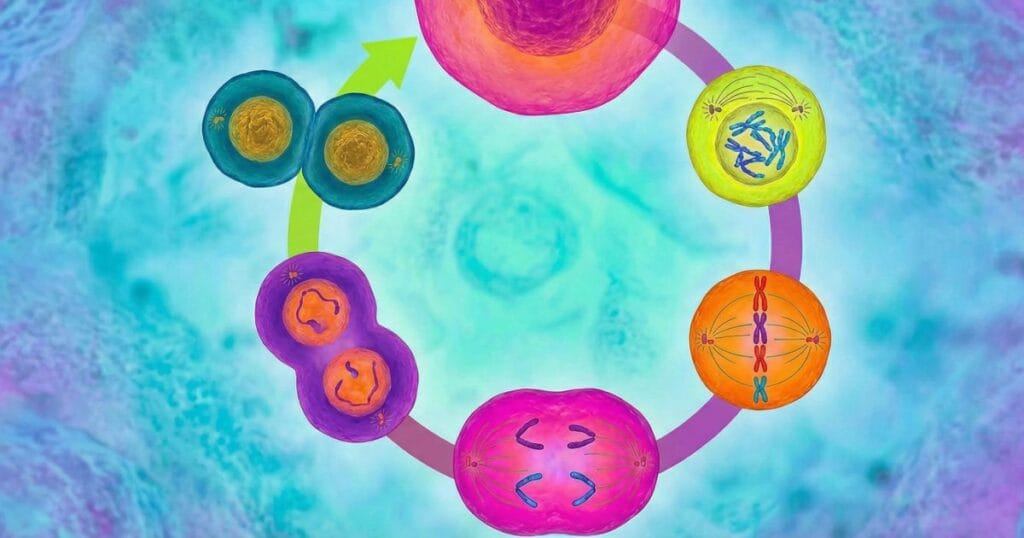
COMPETITIVE EXAM MCQs SERIES of LIFE SCIENCES for CSIR-UGC NET/JRF, SLET, GATE, and other entrance tests – CELLULAR ORGANIZATION – Cell Division and Cell Cycle.
Syllabus Outline
- Types of Cell Division (e.g. mitosis and meiosis).
- Regulation and Control of Cell Division.
- Steps in the cell cycle.
- Regulation and control of the cell cycle.
This quiz contains concept-based, most frequently asked 25 MCQs of “CELLULAR ORGANIZATION – Cell Division and Cell Cycle”. Each question has a single correct/most appropriate answer.
*****
1. In meiotic recombination, a hallmark cytological structure formed during prophase I is:
A) Mitotic spindle
B) Kinetochores
C) Chromocenter
D) Synaptonemal complex
2. Centrosome duplication occurs during:
A) G1 only
B) S phase
C) G2
D) Prophase
3. In meiosis, crossing-over is tightly associated with:
A) Leptotene
B) Zygotene
C) Pachytene
D) Diplotene
4. In mammalian cells, cytokinesis begins during:
A) Mid-prophase
B) Early metaphase
C) Telophase
D) G2
5. Which phase is characterised by terminal differentiation and non-proliferation?
A) G0
B) G2
C) Early S
D) Prometaphase
6. What is the primary function of the “Chromosomal Passenger Complex” during metaphase?
A) To promote sister chromatid cohesion.
B) To degrade Cyclin B.
C) To nucleate microtubules from the centrosome.
D) To destabilise incorrect microtubule attachments.
7. Which phosphorylation event is responsible for the breakdown of the nuclear envelope at the onset of mitosis?
A) Phosphorylation of Histone H3 by Aurora B.
B) Phosphorylation of Lamin B by CDK1-Cyclin B.
C) Phosphorylation of Nucleoporins by Plk1.
D) Phosphorylation of APC/C by CDK1.
8. A researcher performs a cell fusion experiment, fusing a cell in S-phase with a cell in G1-phase. What is the expected outcome for the G1 nucleus?
A) The G1 nucleus will immediately enter S-phase and begin DNA replication.
B) The G1 nucleus will remain in G1 until the S-phase nucleus finishes replication.
C) The G1 nucleus will undergo premature chromosome condensation.
D) The G1 nucleus will enter mitosis immediately.
9. The transition from Metaphase to Anaphase is triggered by:
A) The degradation of Cyclin B.
B) The degradation of Securin, releasing Separase.
C) The phosphorylation of Cohesin.
D) The inactivation of CDK1.
10. In the context of the cell cycle, “Hysteresis” refers to:
A) The reversible nature of the G1/S transition.
B) The bistability of the G2/M switch
C) The linear progression of CDK activation.
D) The redundancy of Cyclins.
11. The cohesin subunit that is cleaved by Separase in mammalian cells is:
A) SMC1
B) SMC3
C) Rad21
D) SA2
12. In a flow cytometry histogram of an asynchronous cell population, the cell fraction with 2N DNA content represents cells in:
A) G0 and G1 phase.
B) S phase.
C) G2 and M phase.
D) Apoptosis.
13. “Endoreplication” results in:
A) Cells with haploid DNA content.
B) Polyploid cells.
C) Cells with multiple nuclei.
D) Enucleated cells.
14. The Synaptonemal Complex is fully formed during which stage of Prophase I?
A) Leptotene
B) Zygotene
C) Pachytene
D) Diplotene
15. A chemical inhibitor of the proteasome is added to cells in Metaphase. What is the expected phenotype?
A) Cells exit mitosis immediately but fail to undergo cytokinesis.
B) DNA re-replication occurs without cell division.
C) Cells arrest in Anaphase A.
D) Cells arrest in Metaphase with condensed chromosomes.
16. In a study of a cancer drug, treated cells show a significant increase in the “Sub-G1” peak on a flow cytometry histogram. This indicates:
A) Arrest in G0.
B) DNA fragmentation associated with Apoptosis.
C) Arrest in early S-phase.
D) Endoreplication.
17. If a microinjected antibody that neutralises Geminin is introduced into a G1 phase cell, what is the likely consequence?
A) The cell will fail to enter S phase.
B) The cell will undergo re-replication within a single cycle.
C) The cell will arrest in G2.
D) The APC/C will remain active indefinitely.
18. In Xenopus egg extracts, the addition of a non-degradable form of Cyclin B results in:
A) Failure to enter mitosis.
B) Rapid degradation of endogenous Cyclin B.
C) Premature cytokinesis.
D) Arrest in a state with high CDK1 activity.
19. Which of the following distinguishes Anaphase A from Anaphase B?
A) Anaphase A involves spindle elongation; Anaphase B involves chromosome movement to the poles.
B) Anaphase A involves chromosome movement to the poles; Anaphase B involves spindle pole separation.
C) Anaphase A requires ATP; Anaphase B requires GTP.
D) Anaphase A is blocked by Taxol; Anaphase B is not.
20. The phosphorylation of the C-terminal domain of RNA Polymerase II is inhibited during mitosis. This leads to:
A) A global cessation of transcription.
B) Increased protein synthesis.
C) Rapid degradation of mRNA.
D) Uncoupling of transcription and translation.
21. Events specific to prophase of mitosis include:
I – Chromosome condensation
II – Nuclear envelope breakdown
III – Centrosome separation
IV – Securin cleavage
A) I and II
B) I and III
C) II and IV
D) I, II, and IV
22. Which of the following mechanisms contributes to the rapid activation of CDK1-Cyclin B at the G2/M transition?
I – Positive feedback loop where CDK1 phosphorylates and activates Cdc25.
II – Positive feedback loop where CDK1 phosphorylates and inhibits Wee1.
III – Nuclear accumulation of Cyclin B.
IV – Degradation of the CDK inhibitor p27.
A) I and II only
B) I, and IV
C) I, II and III
D) II, III and IV
23. Assertion (A): Meiosis I is reductional; meiosis II is equational.
Reasoning (R): Homologous chromosomes separate during meiosis II.
A) Both A and R are true; R explains A
B) A true; R false
C) A false; R true
D) Both A and R are false
24. Assertion (A): In meiosis, cohesion is lost from chromosome arms during Anaphase I, but retained at centromeres until Anaphase II.
Reason (R): The protein Shugoshin recruits Phosphatase 2A to the centromere, which dephosphorylates Rec8, protecting it from cleavage by Separase.
A) Both A and R are correct, and R is the correct explanation for A.
B) Both A and R are correct, but R is not the correct explanation for A.
C) A is correct, but R is incorrect.
D) A is incorrect, but R is correct.
25. Assertion (A): p53 is known as the “guardian of the genome.”
Reason (R): p53 acts as a direct DNA repair enzyme that fixes thymine dimers and double-strand breaks.
A) Both A and R are correct.
B) A is correct, but R is incorrect.
C) A is incorrect, but R is correct.
D) Both A and R are incorrect.
*****
Previous: Organisation of Genes and Chromosomes
Next: Microbial Physiology and Metabolisms
References
- Geoffrey Cooper and Kenneth Adams (2022). The Cell: A Molecular Approach, Oxford University Press, 9th Edition.
- Nelson, David L. & Cox, Michael M. (2021). Lehninger Principles of Biochemistry, W. H. Freeman, 8th Edition.
- Willey, J. M., Sandman, K. M., & Wood, D. H. (2022). Prescott’s Microbiology, McGraw-Hill, 12th Edition
- Verma, P. S., & Agarwal, V. K. (2022). Cell Biology, Genetics, Molecular Biology, Evolution and Ecology, S. Chand Publishing, Revised Edition.
🔗 Explore More MCQs: