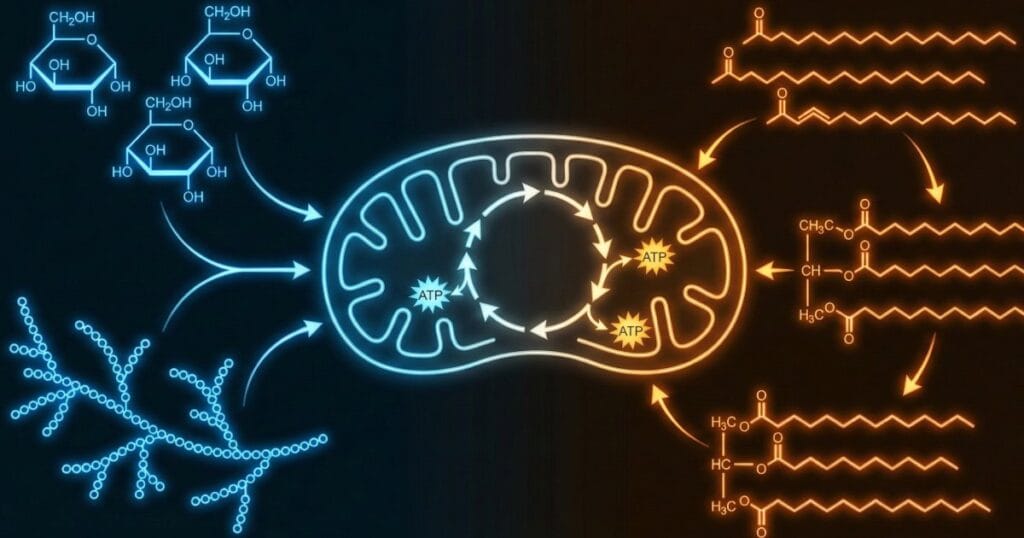
COMPETITIVE EXAM MCQs SERIES of LIFE SCIENCES for CSIR-UGC NET/JRF, SLET, GATE, and other entrance tests – MOLECULES AND THEIR INTERACTION RELEVANT TO BIOLOGY – Carbohydrate and Lipid Metabolism.
Syllabus Outline
- Glycolysis – steps, enzymes, and regulation
- Gluconeogenesis and glycogen metabolism
- Pentose phosphate pathway – oxidative and non-oxidative phases
- Lipid metabolism – beta-oxidation, fatty acid synthesis
- Cholesterol biosynthesis and regulation
- Role of vitamins as coenzymes in metabolism
- Inborn errors of metabolism – examples
- Integration of metabolic pathways and energy balance
This quiz contains concept-based, most frequently asked 25 MCQs of “MOLECULES AND THEIR INTERACTION RELEVANT TO BIOLOGY – Carbohydrate and Lipid Metabolism”. Each question has a single correct/most appropriate answer.
*****
1. Arsenate is similar to inorganic phosphate. When arsenate replaces phosphate in the glycolysis reaction, the product formed breaks down spontaneously. What is the net ATP production from one glucose molecule to two pyruvate molecules when arsenate is present?
A) 2 moles of ATP
B) 4 moles of ATP
C) 0 moles of ATP
D) -2 moles of ATP
2. Which statement correctly describes the differences between Glucokinase (Hexokinase IV) and Hexokinase I?
A) Glucokinase has a lower Km for glucose and is inhibited by Glucose-6-Phosphate.
B) Glucokinase has a higher Km for glucose and is moved to the nucleus by a regulatory protein when glucose is low.
C) Hexokinase-I has a sigmoidal curve and is induced by insulin.
D) Hexokinase-I has a higher Vmax than Glucokinase and is found only in the liver.
3. During intense exercise, muscle lactate is converted back to glucose in the liver (Cori Cycle). How many ATP equivalents does it cost the liver to make one glucose from two lactate molecules?
A) 2 ATP equivalent
B) 4 ATP equivalents
C) 6 ATP equivalents
D) 0 ATP equivalent
4. Which molecule activates Pyruvate Kinase in the liver, linking glycolysis rate to upstream intermediates?
A) ATP
B) Alanine
C) Fructose-1,6-bisphosphate
D) Citrate
5. A mutation in Fructose-1,6-bisphosphate Aldolase (Class I) prevents Schiff base formation. Which amino acid is most likely affected?
A) Cysteine
B) Serine
C) Lysine
D) Histidine
6. In red blood cells, the Pentose Phosphate Pathway produces NADPH. This NADPH is essential for which enzyme to prevent red blood cell breakdown?
A) Methemoglobin Reductase
B) Glutathione Peroxidase
C) Glutathione Reductase
D) Superoxide Dismutase
7. In the oxidative phase of the Pentose Phosphate Pathway, converting 6-phosphogluconate to Ribulose-5-phosphate involves:
A) Oxidation of a hydroxyl group to a ketone and loss of CO2.
B) Breaking a lactone ring.
C) Transfer of a phosphate from ATP.
D) Changing an aldose to a ketose.
8. Muscle contraction triggers glycogen breakdown without hormones. Which molecule directly activates this process?
A) cAMP
B) Calcium
C) AMP
D) Inositol Triphosphate
9. What is the role of Glycogenin in glycogen synthesis?
A) Anchors Glycogen Synthase to the cell membrane.
B) Creates the first α-1,6 branch point.
C) Regulates Protein Phosphatase 1.
D) Acts as a primer by attaching the first glucose molecules to its own Tyrosine residue.
10. Fluoroacetate is a poison that forms Fluorocitrate, which inhibits which enzyme?
A) Citrate Synthase
B) Aconitase
C) Isocitrate Dehydrogenase
D) Succinate Dehydrogenase
11. Which TCA cycle enzyme is embedded in the inner mitochondrial membrane and directly connects to the Electron Transport Chain?
A) Malate Dehydrogenase
B) Succinate Dehydrogenase
C) Fumarase
D) Isocitrate Dehydrogenase
12. Zellweger syndrome results from absent peroxisomes. Which process is primarily affected?
A) β-oxidation of Palmitic acid.
B) β-oxidation of Long Chain Fatty Acids.
C) Cholesterol synthesis.
D) Ketogenesis.
13. To use ketone bodies in tissues outside the liver, acetoacetate needs activation. β-ketoacyl-CoA transferase transfers CoA from:
A) Acetyl-CoA
B) Succinyl-CoA
C) Malonyl-CoA
D) Palmitoyl-CoA
14. Which cofactor is required for Methylmalonyl-CoA Mutase in odd-chain fatty acid oxidation?
A) Biotin
B) Pyridoxal Phosphate
C) Vitamin B12
D) Tetrahydrofolate
15. What is Citrate’s role in fatty acid synthesis?
A) Provides cytosolic Acetyl-CoA.
B) Provides NADPH via Citrate Lyase.
C) Inhibits Fatty Acid Synthase.
D) Activates Carnitine Palmitoyltransferase I.
16. Making Phosphatidylcholine from Phosphatidylethanolamine requires three methylations. The methyl donor is:
A) N5-Methyl-Tetrahydrofolate
B) Methionine
C) S-Adenosylmethionine
D) Betaine
17. During prolonged starvation (3-4 weeks), the brain uses ketone bodies as fuel. What helps preserve muscle protein?
A) Increased liver gluconeogenesis from alanine.
B) Reducing demand for gluconeogenic amino acids.
C) Increased urea excretion.
D) Activation of muscle breakdown by cortisol.
18. Why is ATP-Citrate Lyase essential for fatty acid synthesis?
A) It generates cytosolic Acetyl-CoA from Citrate transported from mitochondria.
B) It converts Acetyl-CoA to Malonyl-CoA.
C) It produces NADPH from Citrate.
D) It transports Palmitoyl-CoA into mitochondria.
19. Which vitamin is needed for the hydroxylation of Proline and Lysine in collagen, stabilising its triple helix?
A) Vitamin C
B) Vitamin D
C) Vitamin K
D) Vitamin B6
20. Which enzyme deficiency causes Niemann-Pick Disease Type A with enlarged liver/spleen and neurodegeneration?
A) Glucocerebrosidase
B) Sphingomyelinase
C) Hexosaminidase A
D) Arylsulfatase A
21. Ethanol metabolism increases liver NADH/NAD+ ratio. What is one consequence?
A) Increased gluconeogenesis from lactate.
B) Inhibition of the TCA cycle.
C) Decrease fatty acid oxidation.
Inhibition of gluconeogenesis.
22. Which statements about gluconeogenesis are correct?
I – Converting Pyruvate to PEP is a single-step reaction by Pyruvate Carboxylase.
II – Glucose-6-phosphatase is in the ER membrane with its active site facing the lumen.
III – Fructose-1,6-bisphosphatase is inhibited by AMP and Fructose-2,6-bisphosphate.
IV – Biotin is needed for PEP Carboxykinase.
A) I and III
B) I, II and III
C) II and IV
D) II and III
23. Which are sources of NADPH for Fatty Acid Synthesis?
I – Malic Enzyme
II – Glucose-6-Phosphate Dehydrogenase
III – 6-Phosphogluconate Dehydrogenase
IV – Isocitrate Dehydrogenase
A) I and II only
B) II and III only
C) I, II, and III
D) I, II, III, and IV
24. Assertion (A): In the liver, ketone body synthesis is directly proportional to β-oxidation rate during fasting.
Reason (R): High NADH from β-oxidation inhibits Isocitrate Dehydrogenase in the TCA cycle, diverting Acetyl-CoA toward ketogenesis.
A) Both A and R are true, and R correctly explains A.
B) Both A and R are true, but R does NOT explain A.
C) A is true, but R is false.
D) A is false, but R is true.
25. Assertion (A): Mammals can make glucose from fatty acids.
Reason (R): The Pyruvate Dehydrogenase reaction is reversible, and mammals have glyoxylate cycle enzymes.
A) Both A and R are true, and R correctly explains A
B) Both A and R are true, but R does NOT explain A
C) A is true, but R is false.
D) Both A and R are false.
*****
Previous: Protein and DNA Stability Factors
Next: Cell Membrane Structure and Function
References
- Nelson, David L. & Cox, Michael M. (2021). Lehninger Principles of Biochemistry, W. H. Freeman, 8th Edition.
- Voet, Donald, Voet, Judith G., & Pratt, Charlotte W. (2018). Voet’s Principles of Biochemistry, Wiley, 5th Edition
- Berg, Jeremy M., Tymoczko, John L., & Stryer, Lubert (2023). Biochemistry, Macmillan Learning, 10th Edition
- Upadhyay, Avinash, Upadhyay, K., & Nath, Nirmalendu (2023). Biophysical Chemistry: Principles and Techniques, Himalaya Publishing House, 4th Edition.
- Verma, P. S., & Agarwal, V. K. (2022). Cell Biology, Genetics, Molecular Biology, Evolution and Ecology, S. Chand Publishing, Revised Edition.
- Alberts, B., Johnson, A., Lewis, J., Morgan, D., Raff, M., Roberts, K., & Walter, P. (2014). Molecular Biology of the Cell, Garland Science, 4th Edition.
🔗 Explore More MCQs: