COMPETITIVE EXAM MCQs SERIES of LIFE SCIENCES for CSIR-UGC NET/JRF, SLET, GATE, and other entrance tests – MOLECULES AND THEIR INTERACTION RELEVANT TO BIOLOGY – Nucleic Acids Structure and Conformation.
Syllabus Outline
- Structural components of nucleic acids – bases, sugar, phosphate
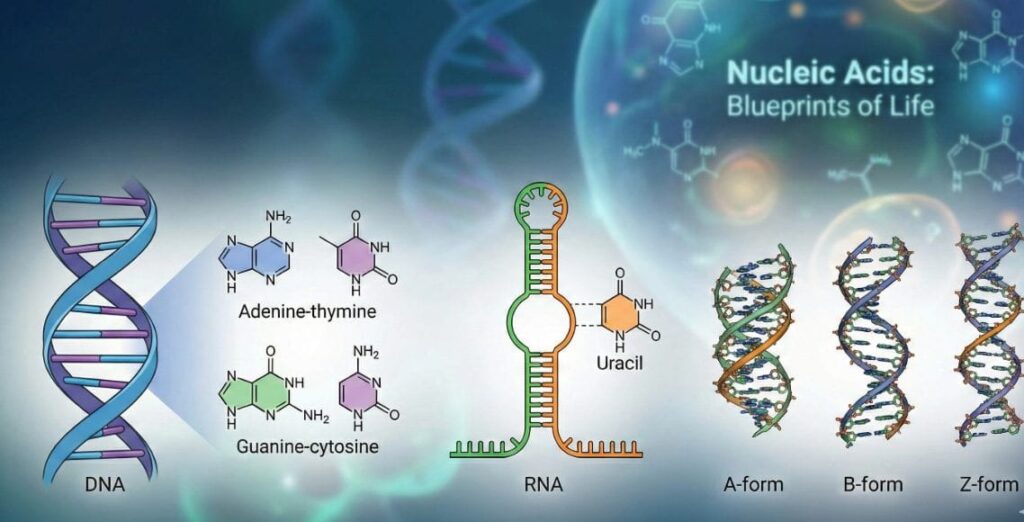
- DNA conformations – A-DNA, B-DNA, Z-DNA and their features
- Base pairing and helical parameters
- tRNA – cloverleaf structure, anticodon, acceptor arm
- rRNA and its structural role in the ribosome
- MicroRNA – biogenesis, function in gene regulation
- DNA supercoiling and topoisomerases
- RNA secondary structures – hairpin, bulges, pseudoknots
- Importance of 3D structure in nucleic acid function
This quiz contains concept-based, most frequently asked 25 MCQs of “MOLECULES AND THEIR INTERACTION RELEVANT TO BIOLOGY – Nucleic Acids Structure and Conformation”. Each question has a single correct/most appropriate answer.
*****
1. Thymine differs from uracil by:
A) an extra amino group at C4
B) a methyl group at C5
C) an extra carbon ring
D) presence only in the DNA helix
2. The nitrogenous base of a nucleotide is attached to which carbon of the sugar?
A) 1′ carbon
B) 3′ carbon
C) 5′ carbon
D) 2′ carbon
3. Which DNA conformation is left-handed?
A) A-DNA
B) B-DNA
C) Both A and B
D) Z-DNA
4. Which sugar puckering is characteristic of A-DNA?
A) C3′-endo
B) C2′-endo
C) C3′-exo
D) C2′-exo
5. Which DNA helix form has the largest diameter?
A) B-DNA
B) Z-DNA
C) A-DNA
D) Both B and Z
6. In circular DNA topology, the linking number equals:
A) Twist
B) Writhe
C) Twist + Writhe
D) Twist – Writhe
7. Uniform diameter of the DNA double helix is ensured by:
A) Pairing of a purine with a pyrimidine
B) Negatively charged backbone on the inside
C) Major grooves are narrow and minor grooves are wide due to hydrogen bonding between base pairs
D) Number of AT base pairs equals GC base pairs in the sequence
8. Which feature is common to all tRNA molecules?
A) A 5′-GGG sequence at the 5′ end
B) An anticodon arm with a GAA loop
C) A conserved CCA sequence at the 3′ end
D) Three anticodon loops in the cloverleaf
9. The D loop of tRNA is so named because it contains:
A) Dihydrouridine nucleotides
B) Deoxyuridine instead of uridine
C) A dihedral angle in the backbone
D) Double-stranded RNA
10. The presence of characterises the TΨC loop of tRNA:
A) Pseudouridine
B) Three thymidines in a row
C) A thymine-uracil double base
D) A TATA box
11. The amino acid is covalently attached to tRNA at the:
A) 5′ end containing phosphate
B) D loop
C) 3′-terminal CCA hydroxyl
D) Anticodon loop
12. Which ribosomal component carries the peptidyl-transferase activity?
A) 16S rRNA of 30S subunit
B) Proteins of the large subunit
C) 5S rRNA of 50S subunit
D) 23S rRNA of 50S subunit
13. Which enzyme cleaves pre-miRNA in the cytoplasm to generate the mature miRNA duplex?
A) RNA polymerase II
B) Exportin-5
C) Dicer
D) Drosha
14. MicroRNAs most commonly regulate gene expression by:
A) Enhancing transcription of target genes
B) Base-pairing to 3′-UTRs of mRNAs, causing mRNA degradation
C) Binding to promoters and blocking RNA polymerase
D) Serving as primers for DNA replication
15. Type I DNA topoisomerases differ from Type II in that Type I:
A) Cleaves only one strand of DNA
B) Requires ATP for activity
C) Can introduce negative supercoils
D) Cuts both strands of DNA
16. In prokaryotes, DNA gyrase is an example of:
A) A Type II topoisomerase
B) A Type I topoisomerase
C) An RNA polymerase
D) A DNA ligase
17. During DNA replication, unwinding of the duplex ahead of the replication fork induces:
A) Negative supercoils in front of the fork
B) Relaxed DNA, no supercoils
C) Positive supercoils ahead of the fork
D) Decatenation, not supercoiling
18. The tertiary L-shape of tRNA is important because:
A) It makes tRNA highly stable
B) It allows tRNA to fit into the ribosomal A and P sites
C) It facilitates tRNA from binding to amino acids
D) It enables peptidyl-transferase activity similar to protein-based enzymes
19. Assertion (A): Z-DNA has a left-handed helix.
Reason (R): Z-DNA is favoured by sequences with alternating purine–pyrimidine nucleotides
A) Both A and R are true, and R explains A.
B) Both A and R are true, but R does not explain A.
C) A is true, R is false.
D) A is false, R is true.
20. Assertion (A): Drosha is a nuclear RNase III enzyme involved in microRNA processing.
Reason (R): Drosha cleaves primary miRNA transcripts into precursor miRNA.
A) Both A and R are true, and R explains A.
B) Both A and R are true, but R does not explain A.
C) A is true, R is false.
D) A is false, R is true.
21. Assertion (A): A Type I topoisomerase changes the linking number of DNA by +1 or -1 per cut.
Reason (R): A Type I topoisomerase nicks both strands of DNA.
A) Both A and R are true, and R explains A.
B) Both A and R are true, but R does not explain A.
C) A is true, R is false.
D) A is false, R is true.
22. Which of the following RNA structural elements is correctly described?
I. A bulge loop has unpaired nucleotides on one side of a helix.
II. An internal loop has unpaired nucleotides on both strands.
III. A pseudoknot is formed by nested stem–loops.
IV. A hairpin requires two separate RNA strands.
A) I, II and III only
B) I and III only
C) II and IV only
D) I, II, III and IV
23. Which of the following are involved in microRNA biogenesis?
I – Drosha (microprocessor)
II – Dicer
III – RISC (Argonaute complex)
IV – RNase H
A) I and II only
B) I, II and III only
C) I, II, III and IV
D) II, III and IV only
24. Which of the following statements about DNA structure is correct?
I – The phosphate of one nucleotide attaches to the 5′ carbon of one sugar and the 3′ carbon of the next sugar.
II – The nitrogenous base is attached to the 5′ carbon of the sugar.
III – DNA’s deoxyribose sugar lacks a hydroxyl group on the 2′ carbon.
IV – Purine bases (A, G) consist of a single six-membered ring.
A) I only
B) I and III only
C) III and IV only
D) I, II and III only
25. Under what condition is A-DNA favoured over B-DNA?
I – High humidity
II – Dehydrated state
III – DNA–RNA hybrid
IV – Physiological ideal conditions
V – Alkaline pH
A) I and III only
B) II and III only
C) II, III and V
D) I, IV and V
*****
Previous: Protein Folding and Structure Guide
Next: Protein and DNA Stability Factors
References
- Nelson, David L. & Cox, Michael M. (2021). Lehninger Principles of Biochemistry, W. H. Freeman, 8th Edition.
- Voet, Donald, Voet, Judith G., & Pratt, Charlotte W. (2018). Voet’s Principles of Biochemistry, Wiley, 5th Edition
- Berg, Jeremy M., Tymoczko, John L., & Stryer, Lubert (2023). Biochemistry, Macmillan Learning, 10th Edition
- Upadhyay, Avinash, Upadhyay, K., & Nath, Nirmalendu (2023). Biophysical Chemistry: Principles and Techniques, Himalaya Publishing House, 4th Edition.
- Verma, P. S., & Agarwal, V. K. (2022). Cell Biology, Genetics, Molecular Biology, Evolution and Ecology, S. Chand Publishing, Revised Edition.
- Alberts, B., Johnson, A., Lewis, J., Morgan, D., Raff, M., Roberts, K., & Walter, P. (2014). Molecular Biology of the Cell, Garland Science, 4th Edition.
🔗 Explore More MCQs: