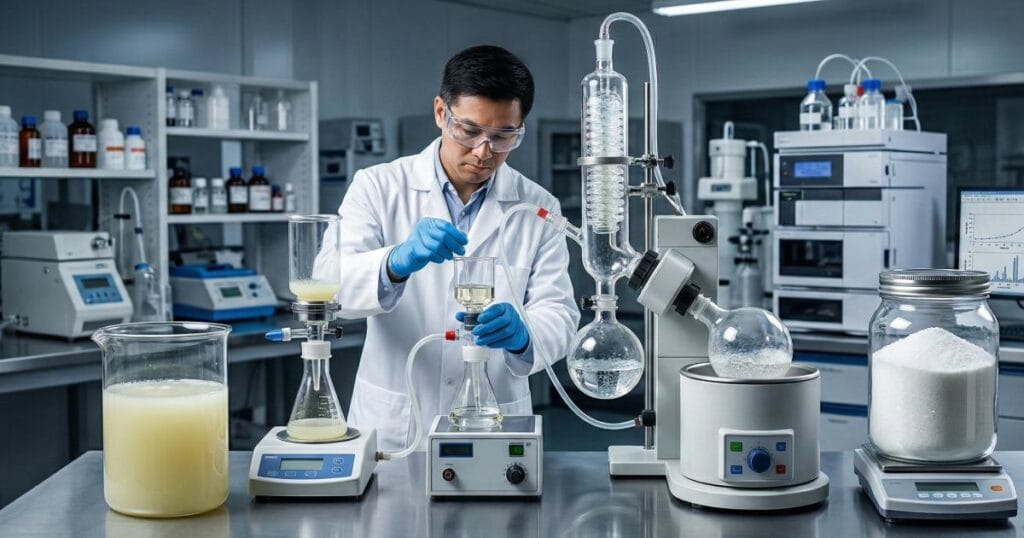
In India, edible lactose is a potential functional carbohydrate in the dairy industry. It is no longer just a byproduct, but is a valuable ingredient in pharmaceuticals, infant nutrition, and functional foods. Edible lactose is the natural sugar of mammalian milk. Its synthesis occurs in the mammary glands by the enzyme lactose synthase.
India is the world’s largest milk producer, with 247.87 million tonnes in 2025. Therefore, efficient lactose management is both an economic priority and a public health concern. The Bureau of Indian Standards (BIS) specification IS 1000:2021 provides a strong regulatory framework for edible lactose, ensuring safety, purity, and compliance with international standards in India. Lactose can become an important ingredient in supporting India’s Biopharma SHAKTI initiative. Therefore, it is important to understand its potential for transforming biomaterials.
What are the basic characteristics of edible lactose?
In aqueous solution, lactose undergoes mutarotation, an intramolecular process in which the α- and β-forms interconvert. At 20°C, the equilibrium mixture contains about 62.7% β-lactose and 37.3% α-lactose.
Studies show that other dissolved substances, such as sucrose or polysaccharides like carrageenan, can slow mutarotation or slightly alter the equilibrium ratio. Carrageenans may also reduce lactose solubility and narrow the metastable zone, the range between the solubility and supersolubility limits that influences crystallisation behaviour.
Below 93.5°C, lactose crystallises mainly as α-lactose monohydrate (C₁₂H₂₂O₁₁·H₂O). This is the preferred commercial form because it is stable and has low solubility (about 7–10 g per 100 g water at 20–25°C). Above 93.5°C, the anhydrous β-lactose becomes the stable solid form and shows much higher solubility.
Lactose may also exist in an amorphous state, typically formed during rapid drying processes such as spray drying. Amorphous lactose is highly hygroscopic (absorbs moisture easily). When it absorbs water, its glass transition temperature decreases. If the glass transition temperature falls below the storage temperature, the material shifts from a hard, glassy state to a soft, sticky state. This leads to caking and unwanted crystallisation in milk powders and other dairy products.
The Valorisation of Whey for Industrial Manufacturing
The main raw material for edible lactose production is whey, the liquid left after milk proteins coagulate during cheese or casein manufacturing. In the past, whey was often discarded as waste. Because it contains high levels of organic matter, it has a BOD of 40–60 g/L and a COD of 50–80 g/L, which can severely pollute water bodies if released untreated.
Modern dairy technology, however, has transformed whey from an environmental liability into a valuable resource by recovering lactose and other nutrients for commercial use. Steps for the Lactose Recovery from Whey are as follows:
Raw Whey
⬇
Ultrafiltration (UF)
Removes proteins
Produces lactose- and mineral-rich permeate
⬇
Nanofiltration (NF) / Reverse Osmosis (RO)
Removes water and small ions
Partial demineralisation (for refined edible grade)
⬇
Evaporation (Multi-effect Vacuum Evaporators)
Concentrates solution to 60–70% total solids
Creates supersaturated lactose syrup
⬇
Crystallization (Controlled Cooling + Seeding)
Cooling from ~70°C to 15–24°C (over 15–24 hours)
Seeding with fine α-lactose monohydrate crystals
Simultaneous nucleation, crystal growth & mutarotation
⬇
Centrifugation
Separation of lactose crystals
⬇
Washing (Cold Water)
Removes residual minerals and proteins
⬇
Drying (Fluidised Bed / Rotary Dryer)
Achieves final moisture specification
⬇
Refined Edible Lactose
Indian Regulatory Landscape: BIS IS 1000:2021
The Bureau of Indian Standards (BIS) regulates edible lactose under IS 1000:2021. This is the second revision of the original 1989 standard. The updated version brings Indian quality requirements in line with international food and pharmaceutical standards. IS 1000:2021 sets strict limits to ensure lactose is safe and suitable for use in products such as infant formula and medicines. Key quality requirements are as follows:
| Parameter | Requirement (IS 1000:2021) |
| Lactose Content (Dry Basis) | Min 99.0% m/m |
| Total Water Content | Max 6.0% m/m |
| Sulphated Ash (Dry Basis) | Max 0.3% m/m |
| pH (10% Solution) | 4.5 – 7.5 |
| Specific Rotation [α]20D | +54.4° to +55.9° |
| Nitrogen (Protein equivalent) | Max 0.1% m/m |
| Arsenic (As) | Max 0.1 mg/kg |
| Lead (Pb) | Max 0.1 mg/kg |
The specification also demands the total absence of pathogens. Microbiological requirements necessitate that Salmonella and Listeria monocytogenes must not be detectable in a 25g sample. In addition, limits for total colony counts and coliforms are strictly enforced.
Under Scheme-IX of the BIS regulations, dairy units manufacturing lactose must implement a Food Safety Management System conforming to IS/ISO 22000. Compliance with the IS 1000:2021 standard allows manufacturers to use the BIS Standard Mark, which is essential for trade and consumer trust in the Indian market.
Nutritional Physiology and Health Considerations
Lactose is the main source of energy for newborn babies. However, its importance in human health changes over time and depends largely on genetic and biological factors.
Lactase and Lactose Digestion
To digest lactose, the body needs an enzyme called lactase-phlorizin hydrolase, which is a product of the LCT gene. Babies naturally produce high levels of lactase. After weaning, lactase levels usually decrease. This condition is known as lactase non-persistence or primary lactose intolerance.
Regional Differences in India
India shows clear regional differences in lactose intolerance:
- North India: Around 27–34% of people show lactose malabsorption. This lower rate is linked to populations with a long tradition of dairy consumption.
- South India: About 66–88% of people show lactose malabsorption. This higher rate is related to genetic differences, particularly the presence or absence of the C/T-13910 variation in the LCT gene region.
Can Lactose-Intolerant People Consume Milk?
Yes, many people with lactose malabsorption can still tolerate small amounts of lactose, usually up to 12 grams per serving, especially when taken with other foods.
Regular intake of moderate amounts of lactose may also lead to colonic adaptation. This means the gut microbiome adjusts over time, increasing lactose-digesting bacteria and reducing digestive discomfort.
Glycemic Impact and Mineral Bioavailability
Lactose has a relatively low glycemic index (GI ≈ 46) compared to other common sugars such as glucose (GI = 100) and sucrose (GI ≈ 65). The glycemic index shows how quickly a carbohydrate raises blood sugar levels.
Lactose raises blood sugar more slowly because of the slower rate of breakdown by digestive enzymes. One of its components, galactose, is processed in the liver and converted into glycogen (stored energy) instead of causing a rapid increase in blood sugar and insulin.
Because of this slower response, lactose becomes a metabolically beneficial carbohydrate for both infants and adults.
Role in Mineral Absorption
Lactose also helps the body absorb important minerals such as calcium and magnesium. When some lactose is not fully digested, it is fermented by beneficial gut bacteria. This process produces organic acids that: lower the pH in the intestine, increase the solubility of calcium and magnesium and improve their absorption through the intestinal wall.
This mechanism is especially important for bone development in breast-fed infants, where efficient calcium absorption is essential for proper bone mineralisation.
Market Opportunities and Industrial Applications of Lactose
The Indian lactose market is projected to grow at a compound annual growth rate of about 6.7% through 2032. This growth is largely due to expanding pharmaceutical and infant formula sectors.
1. Pharmaceutical Uses of Lactose
Lactose is one of the most widely useful pharmaceutical excipients (inactive ingredients in medicines). This is because of its stability, safety, non-reactivity, and ease of compressing into tablets.
In the dairy industry, lactose is also useful to standardise the protein content of milk powders, helping maintain consistent nutritional quality.
Lactose can become an important ingredient in supporting India’s Biopharma SHAKTI initiative, which promotes bio-based medicines and advanced biologics to strengthen the country’s biotechnology sector. However, this growth must be guided by sound scientific principles, because a natural origin does not always guarantee safety.
2. Lactose in Infant Nutrition
Human milk contains about 7 g of lactose per 100 mL, which is higher than cow’s milk (around 4.6 g per 100 mL). Because of this, lactose plays a major role in infant formula design.
In India, the infant formula market is growing rapidly due to urbanisation and the increasing number of working women.
Although lactose-free formulas are available for infants with diagnosed intolerance, replacing lactose with glucose polymers or corn syrups (which have very high glycemic index values, sometimes above 100) may raise concerns about long-term metabolic health.
3. Technological Innovations and Value-Added Products
The future of lactose lies in converting it into high-value functional ingredients, including Galacto-oligosaccharides, Lactulose, and Tagatose, using enzymatic and chemical processes.
- Galacto-oligosaccharides are produced from lactose using enzymes such as beta-galactosidase. They act as powerful prebiotics that promote the growth of beneficial gut bacteria like Bifidobacteria and Lactobacilli. The global Galacto-oligosaccharides market is expanding exponentially.
- Lactulose is produced by converting part of the lactose molecule into fructose. It is useful as a medicine to treat chronic constipation and hepatic encephalopathy.
- D-Tagatose, A Low-Calorie Sweetener, is made from galactose through enzymatic conversion. It is about 92% as sweet as sugar but provides only 1.5 kcal per gram and has a very low glycemic index. Biotechnology can improve tagatose production from dairy-derived galactose, making it a promising option for diabetic-friendly and low-calorie food products.
Sustainability and Whey Utilisation for Edible Lactose in India
The dairy industry is under increasing pressure to reduce its environmental impact. Efficient use of whey (a by-product of cheese production) is important for sustainability.
Untreated whey contains high organic matter and can cause water pollution if discharged directly. Extracting lactose from whey can reduce COD from the wastewater.
The remaining delactosed whey can be treated through anaerobic digestion to produce biogas. This can help dairy plants reduce energy costs and improve sustainability.
The Future of Edible Lactose in India
The scientific and industrial landscape of edible lactose in India is rapidly evolving. Earlier, whey was treated mainly as a waste product and environmental problem. Today, it is processed into high-purity lactose that meets the requirements of IS 1000:2021. This shift shows how advanced and organised the Indian dairy industry has become. Key Takeaways include:
- Regulatory Compliance is Essential: A clear understanding of BIS Scheme-IX and the testing requirements under IS 1000:2021 is crucial. Companies that meet these standards can enter high-value pharmaceutical and export markets.
- Technological Advancement Drives Competitiveness: Future success will depend on improving crystallisation processes and using advanced membrane technologies. These methods help produce refined lactose with controlled particle size and consistent quality.
- Health-Focused Product Development: Since lactose intolerance is common in parts of South India, there is strong potential to develop lactose-derived products such as galacto-oligosaccharides and lactulose. These ingredients support gut health and use natural colonic adaptation mechanisms.
- Sustainability Must Be Integrated: Recovering energy from delactosed whey and exploring emerging technologies like precision fermentation will be important for long-term environmental and economic sustainability.
As India strengthens its position as a global dairy and biopharma leader, the edible lactose sector demonstrates how scientific knowledge can be useful for industrial progress and better nutrition and health for society.