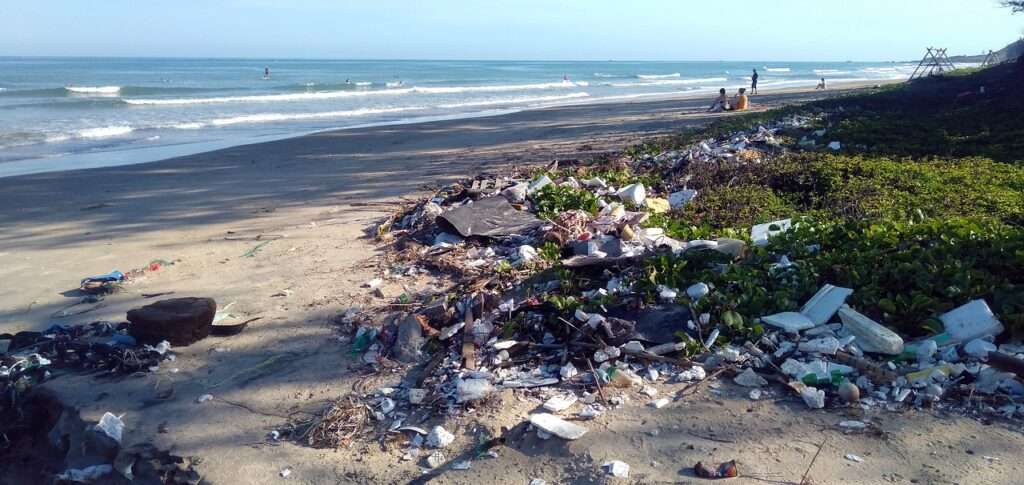
Not all forms of pollution are visible in the air we breathe or the water we drink. Radioactive, Thermal, and Marine Pollution represent distinct environmental challenges that can alter ecosystems, threaten biodiversity, and impact human health on local and global scales. From radioactive contaminants and waste heat discharge to the accumulation of pollutants in oceans and coastal environments, understanding the sources, impacts, and control measures of these pollutants is essential for effective environmental management. These concepts are highly relevant for UGC-NET/JRF, SLET, ARS, GATE, and other competitive examinations.
Use this curated MCQ bank to assess your conceptual understanding, identify knowledge gaps, and strengthen your preparation for competitive examinations.
Syllabus Outline
- Natural and anthropogenic sources of radioactive contamination (e.g. nuclear power plants, mining activities, medical applications, and nuclear accidents).
- Types of radioactive pollutants (e.g. alpha, beta, and gamma radiation).
- Transport, fate, and bioaccumulation of radioactive pollutants in the environment.
- Effects of radioactive pollution on human health, ecosystems, and biodiversity.
- Sources of thermal pollution (e.g. industrial discharges and power plant cooling systems).
- Effects of thermal pollution on aquatic ecosystems (e.g. changes in water temperature, dissolved oxygen levels, and biodiversity).
- Role of thermal pollution in altering nutrient cycling and ecological processes.
- Sources of marine pollution (e.g. land-based runoff, industrial discharges, oil spills, marine debris, and atmospheric deposition).
- Effects of marine pollution on marine ecosystems.
- Types of marine pollutants (e.g. plastics, heavy metals, pesticides, nutrients, pathogens, and persistent organic pollutants).
Quick Study Guide
Evaluating radioactive, thermal, and marine pollution requires analysing the physical, chemical, and biological mechanisms that disrupt aquatic, atmospheric, and geospheric equilibrium.
- Radioactive Decay and Radionuclide Eco-Kinetics: Unstable atomic nuclei stabilise by emitting ionising radiation (α, β, λ particles). This radioactive decay follows first-order kinetics, quantified by a specific half-life (t1/2). Radionuclides pose long-term ecological risks through biochemical mimicry: Strontium-90 mimics calcium and deposits in bone tissue, while Caesium-137 mimics potassium and accumulates in muscle tissue, causing chronic internal irradiation.
- Thermal Pollution and Oxygen Dissolution Dynamics: Discharging high-temperature cooling water from power plants into aquatic ecosystems alters localised thermodynamic balances. Gas solubility principles dictate that as fluid temperature increases, the saturation concentration of DO decreases. Concurrently, elevated temperatures accelerate the metabolic rates and respiratory oxygen demands of ectothermic aquatic organisms, compounding hypoxic stress.
- Marine Oil Spill Weathering and Ecotoxicity: Petroleum influx into marine environments triggers a sequence of physical and chemical weathering processes. Crude oil forms a surface slick that undergoes evaporation, photo-oxidation, and emulsification. The heavy, hydrophobic fractions, predominantly Polycyclic Aromatic Hydrocarbons, resist biodegradation, accumulate in benthic sediments, and exhibit high mutagenicity and chronic toxicity to marine biota.
- Marine Eutrophication and Benthic Hypoxia: Anthropogenic runoff delivers limiting nutrients (primarily nitrogen in marine systems) to coastal zones, triggering rapid pelagic algal blooms. When this massive organic biomass dies and sinks, benthic heterotrophic bacteria consume available oxygen to decompose it. This rapid mineralisation creates anoxic or hypoxic zones (DO < 2 mg/L), leading to widespread mortality in non-motile benthic communities (dead zones).
- Methylmercury Transformation and Biomagnification: Heavy metals deposited into marine systems undergo chemical and biological shifts. In anoxic marine sediments, anaerobic bacteria convert inorganic mercury into lipophilic methylmercury. Because this organometallic compound is easily absorbed and slowly excreted, its concentration amplifies at each successive trophic level through biomagnification, reaching toxic thresholds in apex marine predators.
Test Your Knowledge
This quiz contains 25 concept-based MCQs on “Radioactive, Thermal and Marine Pollution”. Each question has a single correct/most appropriate answer.
*****
1. Which of the following is the primary cause of ionising radiation that affects the activities of most enzymes?
a) Photoemission of electrons
b) Structural change of enzyme by α-particles, β- and γ-rays
c) Interaction of electrons with the body
d) Interaction of radiation with substrate
2. Which radioactive element is classified as an indoor pollutant?
a) Oxygen-16
b) Nitrogen-13
c) Carbon-14
d) Radon
3. Which of the following types of radiation has the highest penetration power?
a) Alpha radiation
b) Beta radiation
c) Gamma radiation
d) Neutron radiation
4. Which of the following organs is most sensitive to the effects of ionising radiation?
a) Liver
b) Skin
c) Bone marrow
d) Kidneys
5. What is the primary pathway through which radioactive pollutants enter the human body?
a) Inhalation
b) Ingestion
c) Dermal absorption
d) Injection
6. What is the main environmental concern associated with radioactive pollution?
a) Acid rain formation
b) Ozone depletion
c) Global warming
d) Long-term health effects
7. In which unit is the biological effect of radiation on living tissue measured?
a) Roentgen
b) Gray
c) Sievert
d) Curie
8. What is the primary reason for long-term storage of radioactive waste?
a) To prevent radioactive decay
b) To reduce the risk of accidental exposure
c) To minimise baseline radiation levels in the environment
d) To promote the spread of radiation
9. What is the main factor determining the biological effects of radiation exposure?
a) Type of radiation
b) Distance from the radiation source
c) Duration of exposure
d) Individual susceptibility
10. Which aquatic organism is more sensitive to changes in water temperature caused by thermal pollution?
a) Phytoplankton
b) Zooplankton
c) Fish
d) Algae
11. How does thermal pollution affect dissolved oxygen levels in aquatic ecosystems?
a) It increases dissolved oxygen levels.
b) It decreases dissolved oxygen levels.
c) It does not affect dissolved oxygen levels.
d) It causes fluctuations in dissolved oxygen levels.
12. What is the primary mechanism through which thermal pollution can harm aquatic organisms?
a) Alteration of pH levels
b) Disruption of reproductive cycles
c) Increased sedimentation rates
d) Oxygen depletion
13. How does thermal pollution impact the efficiency of wastewater treatment plants?
a) It enhances treatment efficiency.
b) It reduces treatment efficiency.
c) It does not affect treatment efficiency.
d) It increases the lifespan of treatment facilities.
14. How does thermal pollution impact the behaviour of aquatic organisms?
a) It does not affect behaviour
b) It stimulates feeding activity
c) It disrupts migration patterns
d) It promotes territorial aggression
15. Which pollutant is commonly associated with thermal discharges from power plants?
a) Heavy metals
b) Pesticides
c) Pathogens
d) Mercury
16. What is the primary mechanism through which thermal pollution affects the reproductive success of aquatic organisms?
a) Alteration of hormone levels
b) Disruption of mating behaviour
c) Enhanced egg fertilisation rates
d) Reduction in offspring survival
17. Which of the following is a potential consequence of thermal pollution on aquatic ecosystems?
a) Decreased evaporation rates
b) Increased primary productivity
c) Expansion of hypoxic zones
d) Promotion of biodiversity
18. What is the primary concern associated with thermal pollution in marine ecosystems?
a) Coral bleaching
b) Ocean acidification
c) Salinity fluctuations
d) Sea level rise
19. How does thermal pollution affect the dissolved oxygen levels in the hypolimnion of stratified lakes?
a) It increases dissolved oxygen levels.
b) It decreases dissolved oxygen levels.
c) It does not affect dissolved oxygen levels.
d) It promotes algal blooms.
20. Which of the following is a potential long-term consequence of thermal pollution on aquatic ecosystems?
a) Accelerated eutrophication
b) Restoration of natural habitats
c) Recovery of fish populations
d) Extinction of sensitive species
21. What is the primary form of pollution caused by excess nutrients in coastal waters?
a) Thermal pollution
b) Chemical pollution
c) Eutrophication
d) Radioactive pollution
22. Which of the following pollutants is commonly associated with ocean acidification?
a) Carbon monoxide
b) Sulfur dioxide
c) Carbon dioxide
d) Nitrogen oxides
23. What is the primary mechanism through which microplastics enter marine ecosystems?
a) Plastic usage and discharge due to marine fishery and coastal aquaculture
b) High-speed circulation of atmosphere and deposition on the water surface
c) Surface runoff
d) Deep-sea mining and oil exploration
24. Which of the following pollutants is commonly associated with red tides?
a) Heavy metals
b) Oil
c) Harmful algal blooms
d) Plastic debris
25. What is the primary route of exposure for marine organisms to persistent organic pollutants?
a) Inhalation
b) Ingestion
c) Dermal absorption
d) Injection
*****
Previous: Soil Microorganisms and Their Functions
Next: Characterisation of Solid and Hazardous Waste
References
- De, Anil Kumar and De, Arnab Kumar (2024). Environmental Chemistry, New Age International, 11th Edition.
- Odum, Eugene P., and Barrett, Gary W. (2004). Fundamentals of Ecology, Thomson Brooks/Cole, 5th Edition.
- Singh, J.S., Gupta, S.R., Singh, S.P. & Singh, R. (2026). Ecology, Environmental Science and Conservation, S Chand Publishing, 2nd Edition.
- Erach Bharucha (2017). Environmental Studies, Universities Press, 4th Edition.
🔗 Explore More MCQs: