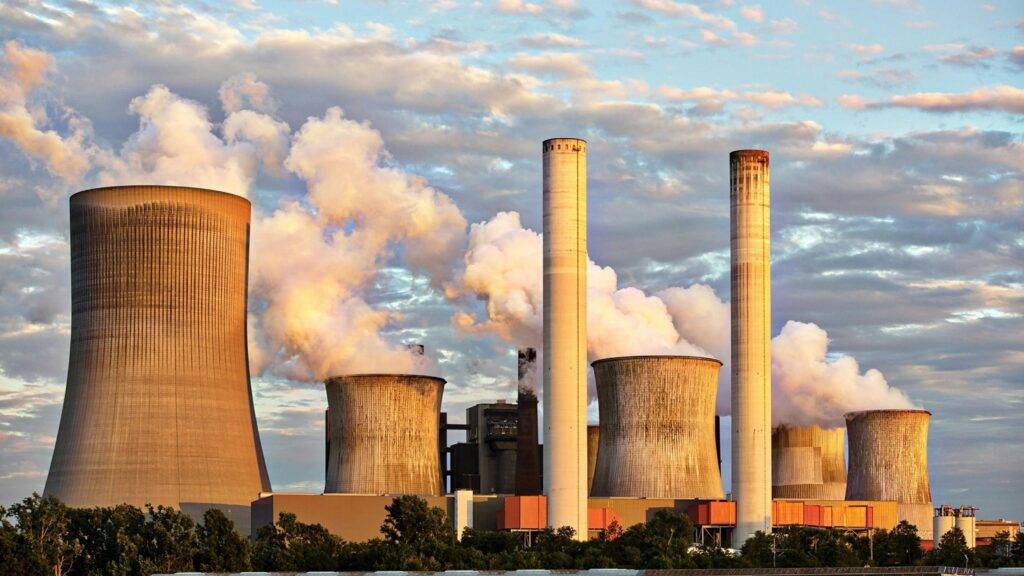
How can the same forces that power the Sun be harnessed to meet humanity’s growing energy needs? Nuclear Fission and Fusion Energy represent two powerful approaches to energy generation, releasing vast amounts of energy from atomic nuclei through fundamentally different processes. While nuclear fission currently contributes to electricity production worldwide, nuclear fusion holds the promise of a cleaner and virtually limitless energy future. Understanding the principles, applications, and environmental implications of these technologies is essential for UGC-NET/JRF, SLET, ARS, GATE, and other competitive examinations.
Use this curated MCQ bank to assess your conceptual understanding, identify knowledge gaps, and strengthen your preparation for competitive examinations.
Syllabus Outline
- Mechanism and process of nuclear fission.
- Chain reaction and criticality.
- Fission reactor types and reactor control (e.g., Pressurised Water Reactor and Boiling Water Reactor)
- Nuclear waste management and safety measures.
- Principles of nuclear fusion and energy release
- Fusion reaction mechanisms (e.g. Magnetic Confinement Fusion and Inertial Confinement Fusion).
- Comparison between nuclear fission and fusion processes.
- Energy output, fuel availability, and waste management.
- Safety considerations and risk assessment.
- Environmental consequences of nuclear energy production (e.g. radiation hazards and environmental contamination).
Quick Study Guide
Nuclear power generation relies on altering the binding energy of atomic nuclei to release thermal energy. These processes are governed by nuclear stability, reaction kinetics, and distinct radioactive decay profiles.
- Nuclear Binding Energy: Nuclear stability is determined by the binding energy holding an atomic nucleus together. Elements naturally shift toward the most stable configuration, which peaks near iron. Heavy nuclei undergo nuclear fission (splitting) to increase their stability, while light nuclei undergo nuclear fusion (combining) to move toward that same stable peak.
- Fission Mechanics and Chain Reactions: Fission occurs when a heavy, unstable nucleus (like uranium-235) absorbs a low-energy thermal neutron and splits into smaller fragments. This rupture releases high-velocity fast neutrons and immense kinetic energy. To sustain a controlled chain reaction, a moderator slows down the fast neutrons so they can trigger further fissions, while control rods absorb excess neutrons to prevent a runaway reaction.
- Fusion Mechanics and Plasma: Fusion occurs when light isotopes combine to form a heavier helium nucleus. For fusion to happen, nuclei must overcome the Coulomb barrier, the electrostatic repulsion between positively charged protons. Overcoming this barrier requires extreme temperatures and pressures that strip electrons from atoms, transforming matter into a high-energy plasma state where nuclear forces can pull the nuclei together.
- Environmental Footprints and Waste: Both processes provide zero-carbon electricity, but their environmental costs differ radically. Fission generates high-level radioactive waste containing unstable isotopes with half-lives spanning thousands of years, requiring deep geological repositories. In contrast, fusion produces no long-lived high-level radioactive waste, carries zero risk of a catastrophic nuclear meltdown, and cannot be weaponised.
Test Your Knowledge
This quiz contains 25 concept-based MCQs on “Nuclear Fission and Fusion Energy“. Each question has a single correct/most appropriate answer.
*****
1. In the context of nuclear fusion, what is the primary function of a neutral beam injector?
a) To provide additional heating to the plasma
b) To extract energy from the fusion reaction
c) To remove impurities from the plasma
d) To control the plasma density
2. In a nuclear fusion reactor, what is the function of the divertor?
a) To extract energy from the fusion reaction
b) To remove impurities from the plasma
c) To absorb excess neutrons
d) To control the plasma density
3. Which type of reactor uses water as both a coolant and a moderator?
a) Pressurised water reactor
b) Boiling water reactor
c) Fast breeder reactor
d) High-temperature water-cooled reactor
4. Which of the following is a major advantage of nuclear fission over fossil fuels?
a) Safer reactor operation
b) Lower operational costs
c) Lower greenhouse gas emissions
d) Abundance of fuel supply
5. What is the main advantage of nuclear fusion over nuclear fission?
a) Abundance of fuel supply
b) Lower radioactive waste production
c) Higher energy efficiency
d) Safer reactor operation
6. What describes the conversion of fertile isotopes into fissile isotopes?
a) Nuclear breeding
b) Nuclear decay
c) Nuclear transmutation
d) Nuclear activation
7. Which of the following fusion reactor concepts utilises a magnetic confinement approach similar to a tokamak but with a different toroidal geometry?
a) Inertial Confinement Fusion
b) Reversed-field pinch
c) Z-pinch
d) Stellarator
8. What is the primary challenge in achieving sustained nuclear fusion reactions on Earth?
a) Obtaining suitable fuel sources
b) Achieving sufficient pressure
c) Containing the high-temperature plasma
d) Overcoming magnetic field limitations
9. What is required to overcome the electrostatic repulsion between atomic nuclei in nuclear fusion?
a) Strong magnetic fields
b) Low temperature
c) High temperature
d) High pressure
10. Which of the following phenomena is responsible for the energy loss during the fusion reaction process in a tokamak?
a) Plasma instabilities
b) Bremsstrahlung radiation
c) Neutron absorption
d) Magnetic confinement losses
11. What is a potential drawback of using breeder reactors?
a) Increased proliferation risk
b) Higher fuel costs
c) Lower energy efficiency
d) Generation of radioactive waste
12. What is the function of control rods in a nuclear reactor?
a) To absorb excess neutrons
b) To moderate the speed of fission reactions
c) To generate electricity
d) To regulate the flow of coolant
13. What is the role of a moderator in a nuclear reactor?
a) To increase the speed of slow neutrons
b) To convert neutrons into protons
c) To absorb excess neutrons
d) To slow down fast neutrons
14. What describes the removal of spent nuclear fuel from a reactor core?
a) Fuel decommissioning
b) Fuel recycling
c) Fuel reprocessing
d) Fuel reloading
15. Which element is involved in the fusion reaction that powers the sun?
a) Plutonium
b) Helium
c) Uranium
d) Hydrogen
16. What is the primary reason for the slowdown in nuclear power expansion?
a) Environmental regulations
b) High construction costs
c) Safety concerns
d) Lack of public support
17. What describes the conversion of enriched uranium into fuel pellets for nuclear reactors?
a) Fuel recycling
b) Fuel fabrication
c) Nuclear reprocessing
d) Uranium enrichment
18. In a Pressurised Heavy Water Reactor, what is the function of heavy water (deuterium oxide)?
a) To cool the reactor core
b) To absorb excess neutrons
c) To enhance reactor efficiency
d) To moderate neutron energy
19. Which of the following isotopes is commonly used in nuclear medicine for imaging and diagnosis?
a) Plutonium-239
b) Uranium-235
c) Technetium-99m
d) Strontium-90
20. What is the significance of the delayed neutron fraction in nuclear reactors?
a) It affects the neutron flux distribution.
b) It determines the reactor’s criticality.
c) It regulates the reactor’s fuel burnup rate.
d) It influences the reactor’s power level stability.
21. Which material is commonly used as a neutron reflector in high-temperature gas-cooled reactors?
a) Heavy water
b) Beryllium
c) Graphite
d) Lead
22. What is the expected ratio of energy output to energy input in a commercial nuclear fusion reactor?
a) 2:1
b) 100:1
c) 1:1
d) 10:1
23. Which experimental device confines and heats plasma to achieve nuclear fusion?
a) Linear accelerator
b) Stellarator
c) Tokamak
d) Cyclotron
24. Which of the following fusion reactor concepts relies on a dense plasma focus to achieve fusion reactions?
a) Tokamak
b) Stellarator
c) Z-pinch
d) Inertial Confinement Fusion
25. What is the primary advantage of using thorium as a nuclear fuel?
a) Safer reactor operation
b) Lower radioactive waste production
c) Higher energy density
d) Abundance in nature
*****
Previous: Hydropower, Tidal and Thermal Energy
Next: Nuclear Reactors and Environmental Harmony
References
- Edward A. Keller (2022). Introduction to Environmental Geology, Pearson, 5th Edition.
- Sharma, P. D. (2017). Environmental Biology and Toxicology, Rastogi Publications, 3rd Edition.
- De, Anil Kumar and De, Arnab Kumar (2024). Environmental Chemistry, New Age International, 11th Edition.
- Singh, J.S., Gupta, S.R., Singh, S.P. & Singh, R. (2026). Ecology, Environmental Science and Conservation, S Chand Publishing, 2nd Edition.
- Erach Bharucha (2017). Environmental Studies, Universities Press, 4th Edition.
🔗 Explore More MCQs: